Introduction
When you’re comparing a fixed rate vs adjustable rate mortgage, you’re facing one of the most consequential financial decisions in the entire home buying process — and most first-time buyers make it without understanding how dramatically different these two loan types really are.
The mortgage type you choose doesn’t just affect your monthly payment. It affects your total interest paid over 30 years, your financial risk level, your ability to plan a household budget, and in some scenarios, whether you can actually afford your home if market conditions shift.
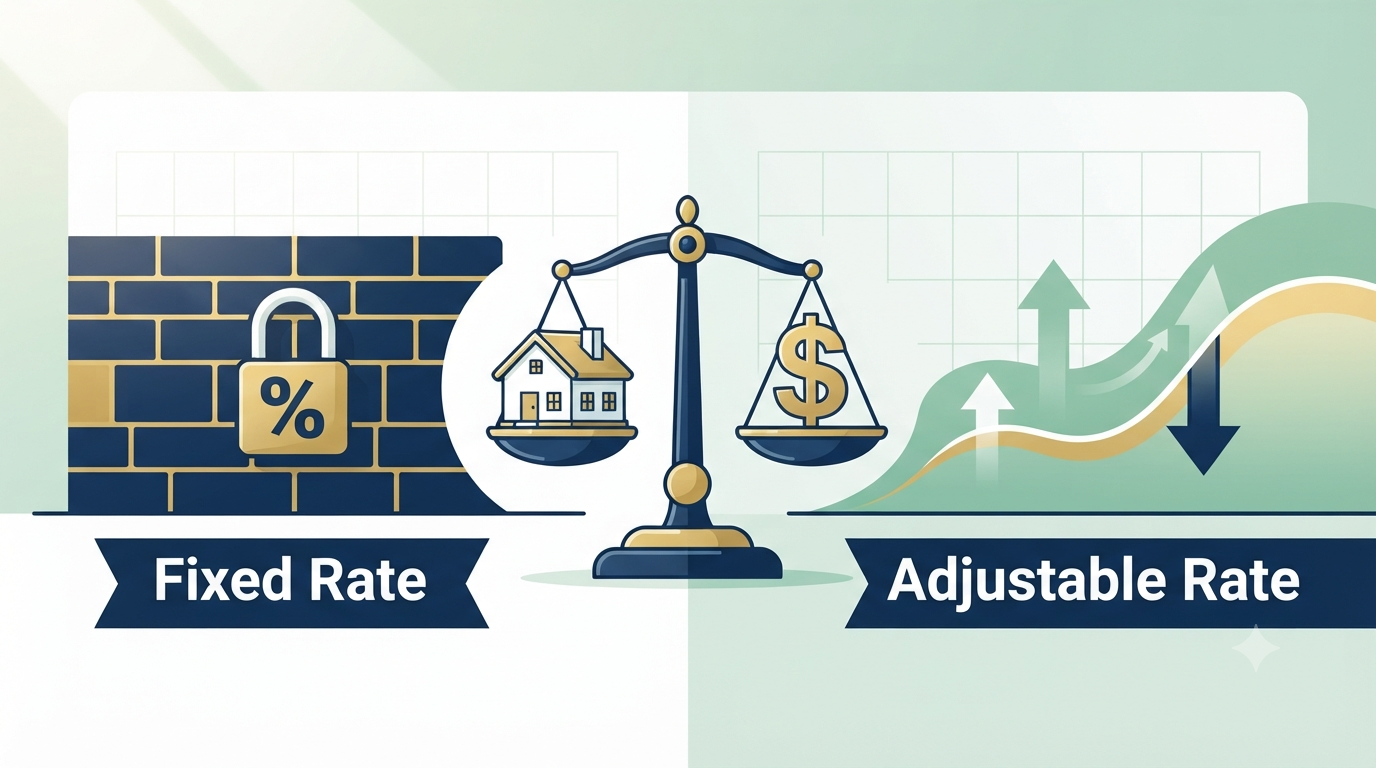
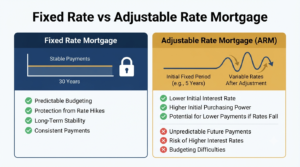
Here’s the core tradeoff in one sentence: a fixed rate mortgage gives you stability and predictability at a slightly higher starting cost. An adjustable rate mortgage (ARM) gives you a lower starting rate and payment — but introduces the risk that your rate could rise significantly after the initial fixed period ends.
10 Fixed-rate mortgages are the go-to for most borrowers, despite adjustable-rate mortgages (ARMs) charging a lower interest rate to start. But in 2026, with rates elevated and the spread between fixed and adjustable rates widening, more buyers are taking a closer look at whether an ARM makes sense for their specific timeline and situation.
This guide breaks down everything — how each mortgage type works, real payment comparisons using 2026 rates, the pros and cons of each, and a clear decision framework so you can choose the right mortgage with confidence. Let’s start with the basics.
📦 QUICK ANSWER BOX (Featured Snippet Target)
Fixed rate vs adjustable rate mortgage — what’s the difference? A fixed rate mortgage locks your interest rate for the entire loan term (typically 15 or 30 years), so your principal and interest payment never changes. An adjustable rate mortgage (ARM) starts with a lower fixed rate for an initial period (typically 5, 7, or 10 years), then adjusts periodically based on market conditions. In 2026, the average 30-year fixed rate is approximately 6.60%, while a 5/1 ARM averages around 6.13% — a difference that translates to real monthly savings upfront, but introduces rate risk after the initial period ends.
What Is a Fixed Rate Mortgage?
10 A fixed-rate mortgage maintains the same interest rate for the life of the loan, so your monthly mortgage payment — the principal and interest portion — won’t change unless you refinance.
This is the simplest and most straightforward mortgage product available — and by far the most popular. 12“Less than 10% of borrowers take ARMs, meaning more than 90% opt for fixed-rate mortgages,” says Bankrate housing market analyst Jeff Ostrowski. “Americans simply prefer the certainty of fixed-rate mortgages over ARMs.”
How a Fixed Rate Mortgage Works
When you close on a fixed rate mortgage, you and the lender agree on an interest rate that day. That rate is locked in permanently — for 15, 20, or 30 years, depending on your loan term. Whether interest rates in the broader economy rise to 10% or fall to 3%, your rate and your principal + interest payment never change.
10 Keep in mind: your total monthly mortgage payments can still change as homeowners insurance premiums or property tax rates rise — but the core mortgage payment stays constant. That predictability is the defining advantage of the fixed rate mortgage.
Fixed Rate Mortgage Terms
10 Fixed-rate mortgages are more popular than ARMs. They typically come in 30-year and 15-year terms, but there are also flexible term options anywhere from eight years to 29 years.
| Term | Monthly Payment | Total Interest Paid | Best For |
|---|---|---|---|
| 30-Year Fixed | Lower | Much higher overall | Buyers who need lower monthly payments |
| 20-Year Fixed | Moderate | Moderate | Balance between payment and total cost |
| 15-Year Fixed | Higher | Much lower overall | Buyers who can afford higher payments and want to pay less interest |
On a $350,000 loan at 6.60%:
- 30-year fixed: ~$2,238/month | Total interest: ~$455,680
- 15-year fixed: ~$3,085/month | Total interest: ~$205,300
The 15-year saves you approximately $250,380 in interest — but requires $847 more per month. That’s the core trade-off within fixed rate options.
Fixed Rate Mortgage — Pros and Cons
| ✅ Pros | ❌ Cons |
|---|---|
| Payment never changes | Higher starting rate than ARM |
| Easy to budget long-term | You don’t benefit if market rates fall (without refinancing) |
| No rate risk regardless of market | Higher monthly payment than ARM initially |
| Best for long-term homeowners | Refinancing required to access lower rates |
| Mentally simple and low-stress | — |
What Is an Adjustable Rate Mortgage (ARM)?
1 A fixed-rate mortgage locks your interest rate for the entire loan term, while an adjustable-rate mortgage offers a lower starting rate that resets on a market index once the introductory window closes.
Most modern ARMs are hybrid ARMs — meaning they have two distinct phases:
- The initial fixed-rate period — Your rate is locked and doesn’t move (typically 5, 7, or 10 years)
- The adjustment period — Your rate resets periodically based on a market index, usually every 6 or 12 months
9 A 5-year ARM is an adjustable-rate mortgage with an interest rate that stays the same for the first five years. After that initial period, the rate adjusts periodically based on changes in the broader market.
How to Read ARM Notation
You’ll see ARM loans written as numbers like 5/1, 7/1, or 10/1. Here’s exactly what those numbers mean:
        5  /  1  ARM
        │     │
        │     └── How often (in years) the rate adjusts AFTER the fixed period
        └──────── How many years the rate stays FIXED at the start
So a 5/1 ARM = fixed for 5 years, then adjusts every 1 year. A 7/1 ARM = fixed for 7 years, then adjusts every 1 year. A 10/1 ARM = fixed for 10 years, then adjusts every 1 year.
Some lenders use a slightly different structure: 9it’s sometimes called the 5/6 ARM, where the “5” refers to the starting fixed-rate period in years and the “6” refers to how often in months the rate is adjusted afterward.
How ARM Rate Adjustments Work
After the fixed period ends, your ARM rate adjusts based on a financial index plus a margin set by your lender. 9The rate adjustments are based on a benchmark index, which in most cases is the Secured Overnight Financing Rate (SOFR), plus a fixed margin set by the lender.
9 The benchmark rate tends to rise when the economy is strong and fall when the economy weakens. This means your ARM payment can go either direction after the fixed period — it could decrease if rates fall, or increase if rates rise.
ARM Rate Caps — Your Protection Against Extreme Changes
1 Rate caps on ARMs limit how much your interest can go up every time it changes and over the life of the loan.
ARM caps are typically expressed as three numbers — for example, 2/2/5 — which means:
- First cap (2): Maximum rate increase at the FIRST adjustment (2 percentage points)
- Periodic cap (2): Maximum rate increase at each SUBSEQUENT adjustment (2 percentage points per year)
- Lifetime cap (5): Maximum rate increase over the ENTIRE life of the loan (5 percentage points total)
Example: If your ARM starts at 6.13% with 2/2/5 caps:
- First adjustment maximum: 8.13%
- Subsequent adjustment maximum: 10.13% (if rates kept rising)
- Lifetime maximum: 11.13% — this is the worst-case rate you could ever face
1 The Consumer Financial Protection Bureau (CFPB) says that you should ask your lender to figure out the highest payment your ARM could ever need. This is essential due diligence before choosing an ARM — you need to know you can afford the worst-case payment.
Adjustable Rate Mortgage — Pros and Cons
| ✅ Pros | ❌ Cons |
|---|---|
| Lower initial rate and payment | Rate and payment can rise after fixed period |
| Can save significantly if you move or refinance before adjustment | Harder to budget long-term |
| May qualify for a larger loan amount | Requires understanding of indexes, caps, and margins |
| Rate can go DOWN if market rates fall | Payment shock possible if rates rise significantly |
| Good short-term strategy in high-rate environments | More complex product than fixed rate |
Fixed Rate vs Adjustable Rate Mortgage — 2026 Real Payment Comparison
This is the section that makes everything concrete. Let’s use real 2026 rate data to show you exactly what these two mortgage types cost — month to month and over the full loan term.
8 As of late July 2026, the average rate on a 5/1 ARM was 6.13%, compared with 6.60% for a 30-year fixed-rate mortgage.
Scenario 1: $300,000 Loan — 30-Year Fixed vs 5/1 ARM
| 30-Year Fixed (6.60%) | 5/1 ARM (6.13%) | |
|---|---|---|
| Monthly P+I Payment | $1,918 | $1,825 |
| Monthly Savings with ARM | — | $93/month |
| Annual Savings with ARM | — | $1,116/year |
| 5-Year Savings with ARM | — | $5,580 |
| After Adjustment (if rate rises to 8.13%) | $1,918 (unchanged) | $2,231 (+$406/month) |
| After Adjustment (if rate falls to 5.13%) | $1,918 (unchanged) | $1,634 (−$284/month) |
The key question: Will you sell or refinance within 5 years to capture the ARM savings — or will you still be in the home when the rate adjusts?
Scenario 2: $350,000 Loan — 30-Year Fixed vs 5/1 ARM
5 In 2026, the 30-year fixed rate is 6.38% and the 5/1 ARM is 5.65% — a $161/month difference on a $350K loan.
| 30-Year Fixed | 5/1 ARM | |
|---|---|---|
| Monthly P+I Payment | ~$2,179 | ~$2,018 |
| Monthly Savings with ARM | — | $161/month |
| 5-Year Total Savings | — | $9,660 |
5 The 5/1 ARM saves $161/month vs the 30-year fixed. Over 5 years, that’s $9,660 saved — before any rate adjustment.
Scenario 3: $500,000 Loan — The High-Balance Picture
| 30-Year Fixed (6.60%) | 7/1 ARM (6.30%) | |
|---|---|---|
| Monthly P+I Payment | $3,197 | $3,097 |
| Monthly Savings with ARM | — | $100/month |
| 7-Year Total Savings | — | $8,400 |
| Worst-Case After Adjustment (8.30%) | $3,197 | $3,789 (+$592/month) |
💡 Key Insight: The larger the loan, the larger the absolute dollar difference between fixed and ARM rates. On a $500,000+ loan, ARM savings are significant — but so is the risk if rates rise after adjustment.
The Break-Even Analysis — When Does an ARM Actually Save You Money?
The break-even point is the moment at which your ARM rate adjustment erases the savings you built up during the fixed period. Understanding this number is critical to making a smart decision.
Break-Even Calculation:
ARM Break-Even = Fixed Period Savings ÷ Monthly Cost Increase After AdjustmentExample using Scenario 1 ($300,000 loan):
- 5-year ARM savings: $5,580
- Monthly payment increase after adjustment (assuming rate rises 2%): +$406
- Break-even: $5,580 ÷ $406 = 13.7 months
This means: if rates rise at adjustment and you stay in the home more than ~14 months past the adjustment date, the ARM starts costing you more than the fixed rate would have.
What this tells you:
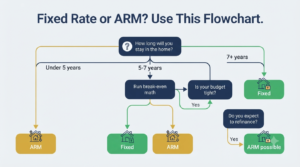
- If you’ll be in the home for less than 5 years → ARM almost certainly wins
- If you’ll be in the home for exactly 5–7 years → Run the break-even math for your specific loan
- If you’ll be in the home for 10+ years → Fixed rate almost certainly wins
When a Fixed Rate Mortgage Is the Right Choice
A fixed rate mortgage makes the most sense in these situations:
✅ You plan to stay long-term (7+ years) The stability of a fixed rate pays off over time. If you’re buying your forever home or plan to stay for a decade or more, locking in your rate eliminates years of rate risk and makes budgeting simple.
✅ You’re buying in a rising rate environment If rates are expected to climb over the coming years, locking in today’s rate protects you from paying more in the future.
✅ You have a tight monthly budget If your budget doesn’t have much room to absorb a payment increase, the predictability of a fixed rate is a form of financial insurance. 5Choose a 30-year fixed if you plan to stay 7+ years, want payment certainty, or have a tight budget that can’t absorb payment increases.
✅ You value mental simplicity A fixed rate mortgage requires zero ongoing monitoring. You never have to think about interest rate indexes, adjustment periods, or caps. For many homeowners, that peace of mind has real value.
✅ You’re buying your forever home
11 If you’re buying your forever home and plan to stay for the foreseeable future without selling or refinancing, a fixed rate eliminates all rate risk for the life of the loan.
When an Adjustable Rate Mortgage Makes Sense
An ARM is not inherently risky — it’s only risky if it’s chosen for the wrong situation. Here’s when it genuinely makes financial sense:
✅ You’re planning to sell within the fixed period
6 If you plan to stay in your home for less than 7 years, an adjustable-rate mortgage usually saves you money. If you know you’ll move before the rate adjusts, you capture the lower rate savings with zero rate risk.
✅ You’re buying a starter home Many first-time buyers buy a starter home — not their forever home. A 5/1 or 7/1 ARM can save you thousands during the years you’re in the home, and you sell before the adjustment hits.
✅ You expect to refinance
8 An ARM may work well if you plan to sell or refinance before the rate adjusts, but if you stay longer, make sure you can afford higher payments if rates rise.
✅ You need a lower payment to qualify
9 A 5-year ARM makes sense if you expect to refinance your mortgage or sell your house before the introductory rate expires. You may be able to qualify for a larger loan because of the ARM’s lower initial payment, which improves your debt-to-income ratio.
✅ You expect interest rates to fall
11 If you expect fixed-rate mortgage rates to decrease, it’s risky and hard to predict, but if you expect fixed-rate mortgage rates to drop below current ARM rates before your introductory period expires, an adjustable-rate mortgage may yield savings until fixed rates drop.
✅ You can financially absorb the worst-case payment If you’ve run the numbers and you can comfortably handle the highest possible payment your ARM could ever reach (based on the lifetime cap), the risk is manageable and the upfront savings are real.
The Risk You Must Never Ignore — Payment Shock
Payment shock is the term for what happens when an ARM adjusts upward significantly and the homeowner can no longer comfortably — or at all — afford the new payment.
6 Payment shock is possible after the fixed period ends. It’s not a theoretical concern — it was one of the major contributing factors to the 2008 housing crisis, when millions of homeowners with short-term ARMs found their payments doubling after the fixed period expired.
Modern ARMs are significantly safer than pre-2008 products — rate caps are stricter and qualification standards are tighter. But the risk of payment shock is real and must be evaluated honestly.
How to Protect Yourself from Payment Shock
1. Always calculate the worst-case payment before signing Using your ARM’s lifetime cap, calculate the maximum rate you could ever face and the monthly payment at that rate. Make sure you can afford it.
2. Build a cash cushion Maintaining a healthy emergency fund gives you a buffer if your payment increases during a period when other costs also rise.
3. Have a refinance plan Know your refinance trigger: if rates rise to X%, you’ll refinance within 60 days. Have a lender relationship ready.
4. Don’t max out your budget with an ARM payment If you’re only comfortable at the ARM’s low initial rate and couldn’t afford the fixed rate equivalent, you may be buying too much house. [ How Much House Can You Afford?]
15-Year Fixed vs 30-Year Fixed — The Decision Within a Decision
If you’ve decided a fixed rate mortgage is right for you, there’s still a major choice: 15-year or 30-year term?
This is a question many first-time homebuyers skip — defaulting to the 30-year because the payment is lower — without realizing the dramatic difference in total cost.
| 15-Year Fixed | 30-Year Fixed | |
|---|---|---|
| Rate (approx. 2026) | ~6.10% | ~6.60% |
| Monthly payment ($350K loan) | ~$2,975 | ~$2,238 |
| Payment difference | +$737/month more | — |
| Total interest paid | ~$185,500 | ~$456,680 |
| Interest savings | $271,180 saved | — |
| Equity built in 5 years | ~$93,000 | ~$30,000 |
| Best for | Higher income, wants to own outright fast | Lower payment priority, tighter budget |
The 15-year saves a staggering amount in interest — but the higher monthly payment means it only makes sense if the payment is genuinely comfortable for your budget. Stretching to hit a 15-year payment while draining your emergency fund or retirement contributions is not the right trade.
Most first-time buyers are better served by a 30-year fixed — which they can always pay down faster voluntarily if their income grows — rather than being locked into a higher mandatory payment.
Fixed Rate vs ARM — The Complete Comparison Table
| Factor | Fixed Rate Mortgage | Adjustable Rate Mortgage |
|---|---|---|
| Starting Interest Rate | Higher | Lower |
| Monthly Payment Stability | ✅ Never changes | ⚠️ Changes after fixed period |
| Rate Risk | None | Yes — can rise at adjustment |
| 2026 Average Rate | ~6.60% (30-yr) | ~6.13% (5/1 ARM) |
| Best Loan Term | 5+ years in home | Under 5–7 years in home |
| Budget Predictability | Excellent | Good initially, uncertain later |
| Total Interest (long-term) | Predictable | Variable — depends on rate changes |
| Complexity | Simple | Moderate — need to understand caps, indexes |
| Refinance Need | Only if rates fall significantly | Strategic — before fixed period ends |
| Mental Stress | Low | Moderate — requires monitoring |
| Best For | Long-term homeowners, stability seekers | Short-term buyers, financially flexible borrowers |
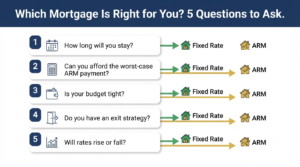
How to Choose: A 5-Question Decision Framework
Answer these five questions honestly. They’ll tell you which mortgage type fits your situation.
Question 1: How long do you plan to stay in this home?
- Less than 5 years → Consider ARM
- 5–7 years → Compare break-even carefully
- 7+ years → Fixed rate strongly preferred
Question 2: Could you afford the worst-case ARM payment?
- Take your ARM’s starting rate + lifetime cap = worst-case rate
- Calculate the monthly payment at that rate
- If you can’t comfortably afford it → Fixed rate only
Question 3: Is your monthly budget tight or flexible?
- Tight budget → Fixed rate (payment stability protects you)
- Flexible budget with reserves → ARM may be viable
Question 4: Do you have a reliable exit strategy before the ARM adjusts?
- Clear plan to sell or refinance → ARM makes sense
- No clear plan → Fixed rate safer
Question 5: Are interest rates likely to rise or fall?
- Rates expected to rise → Lock in fixed now
- Rates expected to fall → ARM lets you ride rates down then refinance
- Uncertain (always) → Fixed rate eliminates the uncertainty
💡 The golden rule: If you have any doubt about whether you’ll move or refinance before the fixed period of an ARM ends, choose the fixed rate. Certainty has value — especially when it’s your home on the line.
What Happens if You Choose the Wrong Mortgage?
Let’s be honest about the consequences — because this is a decision that’s hard to undo cheaply.
If you chose ARM and need to stay longer than planned:
- Your rate adjusts, potentially increasing your payment by hundreds per month
- You may need to refinance — which costs 2–5% of the loan amount in closing costs
- If home values dropped and you have little equity, refinancing may not be possible
- Worst case: payment becomes unaffordable and foreclosure risk rises
If you chose Fixed and rates fell:
- You’re paying a higher rate than necessary
- You can refinance to a lower rate — but it costs 2–5% of loan value in closing costs
- You need to calculate whether the rate savings justify the refinance cost (break-even typically 2–3 years)
The asymmetry of risk: Choosing the wrong ARM in a rising rate environment can lead to unaffordable payments and potential foreclosure. Choosing the wrong fixed rate in a falling rate environment costs you some interest but never threatens your ability to keep your home. For most first-time buyers, this asymmetry is a strong argument for defaulting to the fixed rate when in doubt.
Frequently Asked Questions
Is a fixed rate or adjustable rate mortgage better in 2026?
For most first-time homebuyers in 2026, a 30-year fixed rate mortgage remains the safer and simpler choice — especially if you’re planning to stay in the home long-term. However, if you’re buying a starter home and are confident you’ll sell within 5–7 years, a 5/1 or 7/1 ARM offers meaningful monthly savings. The right answer depends on your timeline, budget flexibility, and risk tolerance — not a universal rule.
How much lower is an ARM rate compared to fixed in 2026?
8 As of late July 2026, the average rate on a 5/1 ARM was 6.13%, compared with 6.60% for a 30-year fixed-rate mortgage — a spread of approximately 0.47 percentage points. On a $350,000 loan, that difference translates to roughly $100–$161 per month in savings during the ARM’s fixed period.
Can my ARM payment ever go down after adjustment?
Yes. 11If current rates are lower, your rate and mortgage payment may decrease. If current rates are higher than the initial rate, your rate and mortgage payment may increase. ARM adjustments go both directions — they’re tied to the market index, which can fall as well as rise.
What is the maximum my ARM rate can ever reach?
Your ARM’s lifetime cap sets the maximum rate increase over the entire loan. A typical lifetime cap is 5 percentage points above the initial rate. So if your ARM starts at 6.13%, the highest rate you could ever face is 11.13%. Always confirm your specific lifetime cap with your lender before signing — and calculate the payment at that maximum rate.
Can I refinance out of an ARM into a fixed rate later?
Yes — refinancing from an ARM to a fixed rate mortgage is a common strategy. However, refinancing is not free: it typically costs 2–5% of the loan balance in closing costs, and you’ll need to qualify again based on your credit score and income at that time. Have a clear refinance plan and timeline before choosing an ARM.
Is a 15-year fixed rate mortgage worth it?
A 15-year fixed rate mortgage saves a dramatic amount in total interest — sometimes $200,000+ compared to a 30-year — but requires a significantly higher monthly payment. It’s worth it if the payment is genuinely comfortable for your budget and doesn’t compromise your emergency fund, retirement contributions, or other financial goals. Never choose a 15-year term if it stretches your budget to the breaking point.
What questions should I ask my lender about an ARM?
Ask your lender: (1) What is the initial fixed rate period? (2) What index does the ARM use? (3) What is the margin? (4) What are the periodic and lifetime caps? (5) What is the worst-case monthly payment I could ever face? (6) When exactly does the first adjustment occur? Getting these answers in writing protects you completely.
Conclusion — Fixed Rate vs Adjustable Rate Mortgage: Your Decision Made Clear
Choosing between a fixed rate vs adjustable rate mortgage is not about which one is objectively better — it’s about which one fits your specific timeline, budget, and risk tolerance.
Here’s the complete summary:
- ✅ Fixed rate = stability, predictability, zero rate risk — best for long-term homeowners and anyone with a tight budget
- ✅ ARM = lower starting rate, real monthly savings — best for short-term buyers with a clear exit strategy before adjustment
- ✅ In 2026, the spread between fixed and adjustable rates makes ARMs worth considering for the right buyer — but not for everyone
- ✅ Always calculate the worst-case ARM payment before signing anything
- ✅ 2Whether you choose an ARM or a fixed-rate mortgage, shop around and get preapproved with at least three lenders to compare offers
- ✅ When in doubt — especially as a first-time buyer — the fixed rate is the lower-risk, more forgiving choice
Your mortgage decision connects directly to everything else in your homebuying plan. If you haven’t yet read the full overview of the process, start with our pillar: [: First-Time Homebuyer Guide]
And before finalizing your mortgage decision, make sure you know your true homebuying budget: [How Much House Can You Afford?]