Here’s the most expensive mistake you can make as a first-time homebuyer: falling in love with a house before you know your number.
It happens constantly. A buyer browses listings, finds a home they adore, and then — only then — starts doing the math to see if they can make it work. That backwards approach leads to two equally bad outcomes: either they stretch their budget dangerously thin to buy the home, or they walk away heartbroken after wasting weeks of emotional energy on something that was never within reach.
The smarter way — the way that leads to genuine financial confidence — is to run your affordability numbers before you ever click on a single listing. That way you’re not trying to make your finances fit a house. You’re choosing a house that fits your finances.
This guide walks you through exactly how to calculate what you can actually afford — not just what a bank will lend you (those are two very different numbers, and the gap between them matters a lot). We’ll cover the formulas lenders use, the rules financial experts recommend, and the real-life factors that influence how much home you should be shopping for.
This is the fourth article in our Home Buying Cluster. If you’re just getting started, begin with our First-Time Homebuyer Guide for the full roadmap, then come back here to nail down your number. Once you know your affordability range, you’ll want to read How to Save for a Down Payment, understand your mortgage options with Fixed vs Adjustable Rate Mortgage, and know what costs to plan for beyond the price tag in Hidden Costs of Buying a Home.
Why “What You Can Borrow” and “What You Can Afford” Are Not the Same Thing
This is the most important concept in this entire article, so let’s get it out of the way first.
When you apply for a mortgage, a lender looks at your income, your debts, your credit score, and a few other factors to determine the maximum loan amount they’re willing to offer you. That number is what you qualify for.
But what you should borrow — what you can comfortably afford without sacrificing your emergency fund, your retirement contributions, your social life, and your general sanity — is almost always a lower number.
Banks are in the business of lending money, not in the business of protecting your monthly cash flow. They don’t know that you want to take two vacations a year, that you plan to have children, that your car is three years away from needing replacement, or that you prioritize investing 10% of your income toward retirement. Their maximum is just that — a maximum, not a recommendation.
Your job in this guide is to find your number, not theirs.
Quick Facts Before We Dive In
- Most financial experts recommend spending no more than 28% of your gross monthly income on housing costs.
- Lenders typically allow a debt-to-income (DTI) ratio of up to 43%, meaning total monthly debts including your mortgage should stay under 43% of gross income — but many recommend staying under 36%.
- Your credit score has a direct impact on the interest rate you qualify for, which dramatically affects what you can afford. See How to Improve Your Credit Score Fast to strengthen this number before applying.
The Key Formulas: How Lenders Calculate Affordability
Understanding how lenders think helps you reverse-engineer their process and arrive at your own number confidently.
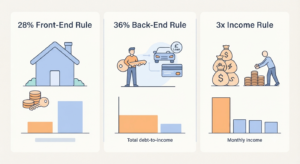
Formula 1: The 28% Rule (Front-End Ratio)
This rule states that your total monthly housing payment — including mortgage principal, interest, property taxes, and homeowners insurance (often called PITI) — should not exceed 28% of your gross monthly income.
Example:
- Gross monthly income: $6,000
- 28% of $6,000 = $1,680 maximum monthly housing payment
This includes everything: principal, interest, taxes, insurance, and HOA fees if applicable. Not just the base mortgage payment.
Formula 2: The 36% Rule (Back-End Ratio / DTI)
Your total debt payments — housing plus all other monthly debts (car payments, student loans, credit card minimums) — should not exceed 36% of your gross monthly income.
Example:
- Gross monthly income: $6,000
- 36% of $6,000 = $2,160 total debt allowed
- Existing monthly debts (car + student loan): $480
- Maximum housing payment = $2,160 − $480 = $1,680
Notice how existing debts eat directly into your housing budget. This is why paying down high-interest debt before applying for a mortgage is so powerful — see How to Pay Off Debt Fast Using the Snowball Method for a practical strategy.
Formula 3: The 2.5x to 3x Annual Income Rule
A classic quick-estimate rule is that your home purchase price should be no more than 2.5 to 3 times your gross annual income.
Example:
- Annual gross income: $75,000
- 2.5x = $187,500
- 3x = $225,000
- Affordable home price range: $187,500–$225,000
This rule is less precise than the DTI calculation but useful as a fast sanity check before running deeper numbers.
Step-by-Step: Calculate Your Home Affordability Number
Let’s work through the full calculation together.
Step 1: Find Your Gross Monthly Income
This is your income before taxes — not your take-home pay.
- If salaried: Annual salary ÷ 12
- If hourly: Average weekly hours × hourly rate × 52 ÷ 12
- If self-employed: Average monthly net income based on last 2 years of tax returns (lenders will want documented proof)
Pro tip: If you’re buying with a partner, add both gross incomes together for a combined household income figure.
Step 2: List All Existing Monthly Debt Payments
Write down every fixed monthly debt payment you currently have:
- Car loan payments
- Student loan minimum payments
- Credit card minimum payments
- Personal loan payments
- Any other installment loans
Do not include: utilities, groceries, subscriptions, or other variable expenses. DTI calculations only count formal debt obligations.
If your existing debts are high relative to your income, your mortgage eligibility shrinks considerably — this is exactly when focusing on debt payoff before house hunting makes a real financial difference.
Step 3: Calculate Your Maximum Monthly Housing Payment
Subtract your total monthly debts from 36% of your gross monthly income:
Maximum Housing Payment = (Gross Monthly Income × 0.36) − Total Monthly Debts
Cross-check: Make sure this number is also under 28% of your gross monthly income on its own.
Step 4: Estimate Your Full Monthly Payment (PITI)
Your monthly mortgage payment includes more than just principal and interest. Budget for:
- Principal + Interest (the base mortgage payment)
- Property Taxes (estimate based on your target area)
- Homeowners Insurance (~$100–$200/month for most homes)
- PMI (if putting less than 20% down, typically 0.5–1.5% of loan amount annually)
- HOA fees (if applicable)
A rough rule of thumb: factor in roughly $200–$400/month beyond your base mortgage payment for taxes and insurance, depending on location. To understand how your loan type affects this number, see Fixed vs Adjustable Rate Mortgage.
Step 5: Work Backwards to a Home Price
Once you have your maximum monthly payment, you can work backwards to a home price using a mortgage calculator:
Example with round numbers:
- Maximum monthly housing budget (PITI): $1,500
- Estimated taxes + insurance: $350/month
- Available for principal + interest: $1,150/month
- Interest rate assumption: 7.0%
- 30-year loan term
- This monthly payment supports a loan of approximately $173,000
- With 10% down ($19,200): Affordable home price ≈ $192,000
This is your shopping range — not the bank’s maximum offer.
Step 6: Factor In the Hidden Costs Buffer
Before finalizing your number, remember: the purchase price isn’t your only upfront cost. You’ll need cash for closing costs, moving expenses, and a post-closing cash reserve. We broke every one of these down in detail in Hidden Costs of Buying a Home. Make sure your savings comfortably cover all of it before settling on a price range.
Key Factors That Affect How Much House You Can Afford
Your maximum affordable home price isn’t just about income and debts. These factors also shift the number meaningfully:
Your Credit Score
Your credit score determines the interest rate you qualify for. A higher rate on the same loan amount means significantly higher monthly payments — which reduces the home price you can afford.
Example impact:
| Credit Score | Approximate Rate | Monthly Payment on $200,000 Loan |
|---|---|---|
| 760+ | 6.5% | ~$1,264 |
| 700–759 | 6.9% | ~$1,319 |
| 650–699 | 7.5% | ~$1,398 |
| 620–649 | 8.2% | ~$1,497 |
A difference of 150+ points on your credit score can change your monthly payment by $200+, and your total interest paid over 30 years by $70,000+. That’s why improving your credit score before applying is one of the highest-return financial moves a homebuyer can make. See How to Improve Your Credit Score Fast for actionable steps.
Your Down Payment Size
A larger down payment reduces your loan amount, eliminates or reduces PMI, and lowers your monthly payment — directly increasing what you can afford at the same monthly budget. See How to Save for a Down Payment for the complete strategy.
Interest Rate Environment
Interest rates change frequently and significantly affect affordability. A 1% increase in interest rates can reduce your affordable home price by roughly 10% while keeping your monthly payment the same.
Property Taxes by Location
Property taxes vary wildly by state and county — sometimes by $300–$800/month for the same home price in different states. Research your target area’s property tax rates before shopping.
Your Emergency Fund
This one doesn’t show up in lender calculations at all, but it’s critical: your emergency fund should be fully intact after closing, not depleted by it. If buying a home means your emergency savings drop to zero, you’re taking on serious financial risk the moment something goes wrong. See How to Build an Emergency Fund From Zero to make sure this is covered before you close.

The Lender’s Max vs. Your Comfortable Max: A Side-by-Side Comparison
Let’s look at a concrete example to see exactly how these two numbers diverge.
Meet Marcus and Priya:
- Combined gross monthly income: $8,500
- Existing monthly debts: $650 (one car loan + student loan minimums)
- Credit score: 720 (qualifies for competitive rate)
| Lender’s Maximum | Their Comfortable Maximum | |
|---|---|---|
| DTI used | 43% | 36% |
| Total debt allowed | $3,655 | $3,060 |
| Minus existing debts | $650 | $650 |
| Max housing payment | $3,005 | $2,410 |
| Corresponding loan (at 7%) | ~$450,000 | ~$362,000 |
| With 10% down | ~$500,000 home | ~$402,000 home |
| Monthly discretionary cushion | Tight | Comfortable |
| Emergency fund impact | Likely strained | Protected |
Marcus and Priya qualify to buy a $500,000 home, but the financially safer choice puts them in the $400,000 range — leaving room for retirement contributions, vacations, repairs, and life’s inevitable surprises without feeling house-poor every month.
The “House Poor” Trap — And How to Avoid It
“House poor” describes a homeowner who stretches so far to buy a home that they can barely afford anything else. Monthly cash is eaten entirely by housing costs, leaving no room to save, invest, enjoy life, or handle surprise expenses comfortably.
The house poor trap is seductive because banks approve it, real estate agents encourage it (their commission grows with your price), and the homes at the top of your budget always look more impressive than the ones at the bottom.
To avoid it:
- Apply the 28/36 rule strictly, not leniently
- Use your comfortable DTI (36%) rather than the lender’s max (43%)
- Keep your emergency fund fully intact post-closing
- Budget realistically for maintenance — at least 1–2% of home value annually
- Factor in the ongoing lifestyle costs of your target neighborhood
A smaller home you can genuinely afford beats a bigger home that financially stresses you every single month.
Quick Reference: Affordability by Income Level
| Gross Annual Income | 28% Monthly Housing Budget | Approx. Affordable Home Price (10% down, 7% rate) |
|---|---|---|
| $45,000 | $1,050/month | ~$130,000–$145,000 |
| $60,000 | $1,400/month | ~$175,000–$195,000 |
| $75,000 | $1,750/month | ~$220,000–$245,000 |
| $90,000 | $2,100/month | ~$265,000–$295,000 |
| $120,000 | $2,800/month | ~$355,000–$395,000 |
Note: These are estimates assuming minimal existing debt, average property taxes, and current rate environment. Your actual numbers will vary.
How to Increase Your Affordable Home Price
If your current number feels discouraging, these strategies directly increase what you can comfortably afford:
1. Improve your credit score — even a 50-point improvement can significantly lower your rate and expand your budget.
2. Pay down existing debts — reducing your DTI opens up more room for your housing payment.
3. Save a larger down payment — lowers your loan amount, eliminates PMI, and reduces monthly payments.
4. Increase your income — a raise, side income, or second earner on the application all expand your range.
5. Buy in a lower-tax area — researching property tax rates across your target region can unlock meaningfully better affordability for the same home price.
6. Extend your timeline — an extra year of saving and debt payoff can substantially change your affordability calculation. Revisit How to Create a Monthly Budget That Actually Works and apply the 50/30/20 Budget Rule to accelerate your financial preparation.
Frequently Asked Questions
Q: How much house can I afford on a $60,000 salary? Using the 28% rule, your monthly housing budget is roughly $1,400. With 10% down and current rates, this typically supports a home price in the $175,000–$195,000 range, depending on your existing debts, location, and credit score.
Q: Is it better to use the 28% or the 36% rule? Use both — the 28% rule sets your housing payment ceiling, and the 36% rule ensures your total debt load stays manageable. Your final number should satisfy both, not just one.
Q: How much do I need to earn to buy a $300,000 house? Very roughly, a $300,000 home requires a gross annual income of around $75,000–$90,000, assuming 10% down, minimal existing debts, and current interest rates. Run the full calculation with your specific debts and credit score for accuracy.
Q: Does my credit score really affect how much house I can afford? Yes, significantly. A lower credit score means a higher interest rate, which increases your monthly payment and reduces the home price you can reach at the same monthly budget. Improving your credit score before applying is one of the best returns on time you can get as a future homebuyer.
Q: What if the bank pre-approves me for more than I calculated? Use your own calculation, not the bank’s maximum. Lenders approve based on what you qualify for, not what leaves you financially comfortable. The difference can be substantial.
Q: Should I include my bonus or side income in my affordability calculation? Be conservative. Most mortgage applications use base salary. If your bonus income is irregular, basing your affordability on it is risky — your mortgage payment exists every month, whether the bonus arrives or not.
Final Thoughts: Know Your Number First, Then Find Your Home
The single most empowering thing you can do as a first-time buyer is calculate your real affordability number before you fall in love with a house. It removes the emotional decision-making, keeps your finances healthy, and turns one of life’s biggest purchases into a genuinely positive experience instead of a stressful one.
Your comfortable affordable home price is based on four things: your income, your debts, your down payment, and your credit score. Work on all four before you apply, and you’ll not only qualify — you’ll qualify comfortably, with room in your budget for a life beyond your mortgage payment.
From here, your next steps are clear: make sure your Down Payment Savings Plan matches the home price range you’ve calculated here, understand how mortgage type affects your monthly payment in Fixed vs Adjustable Rate Mortgage, and account for everything beyond the purchase price in Hidden Costs of Buying a Home.
This article is for educational purposes only and does not constitute financial, mortgage, or legal advice. Please consult a licensed mortgage professional or financial advisor for personalized guidance.
Related Articles