
Most people don’t fail at budgeting because they’re bad with money. They fail because the budget they built didn’t match how they actually live. They download a template built for someone else’s life, plug in numbers that feel aspirational rather than real, and by day twelve the whole thing falls apart. Then they conclude budgeting “just isn’t for them.”
It’s not that budgeting doesn’t work. It’s that most budgets are built backward.
This guide walks through how to create a monthly budget the way it should be built: starting from your real numbers, not your ideal ones, and designing something flexible enough to survive an actual month. By the end, you’ll have a working system, not just a spreadsheet you abandon in two weeks.
Why Most Budgets Fail Before They Start
Before getting into the how, it’s worth understanding the why — because if you’ve tried budgeting before and quit, it probably wasn’t your fault.
Three things sink most first-time budgets:
- The numbers are guesses, not facts. People estimate what they spend on groceries or eating out instead of checking. The guess is almost always lower than reality.
- The categories are too rigid. A budget with twenty tiny categories (coffee, parking, snacks, streaming) collapses the moment life doesn’t cooperate.
- There’s no plan for irregular expenses. Car repairs, birthdays, annual subscriptions — these get treated as “surprises” every single time, even though they’re predictable if you zoom out to a full year.
A budget that works isn’t the one with the prettiest spreadsheet. It’s the one built from real data, with categories wide enough to bend without breaking.
Step 1: Find Out What You Actually Earn
Start with income, because this is the one number people usually get wrong in a way that causes problems later.
If you’re on a salary with taxes withheld, use your net pay — what actually lands in your bank account — not your gross salary. If your income varies (freelance, tips, commission, gig work), don’t use your best month. Instead:
- Pull your last 3–6 months of income
- Average it, or use your lowest realistic month as your baseline
- Treat anything above that baseline as a bonus to be allocated later, not spent in advance
Budgeting off your best month is one of the fastest ways to end up short. Budgeting off your worst realistic month means every good month feels like a win instead of a scramble.
Step 2: Track Where Your Money Is Actually Going
This is the step people skip, and it’s the one that matters most.
Pull your last full month of bank and credit card statements and sort every transaction into a small number of categories. Don’t overthink the categories at this stage — you’re just gathering evidence.
A simple starting list:
- Housing (rent/mortgage, utilities)
- Transportation (car payment, gas, transit)
- Food (groceries and eating out — track separately, they behave very differently)
- Debt payments (minimums on loans and credit cards)
- Subscriptions (streaming, apps, memberships)
- Everything else (this becomes its own category later)
Most people are surprised by at least one number in this exercise — usually food, subscriptions, or “everything else.” That surprise is useful information, not something to feel bad about. You can’t fix a number you’ve never actually looked at.
Step 3: Choose a Budgeting Method That Fits Your Life
There isn’t one “correct” budgeting method — there’s the one you’ll actually keep using. Three of the most common approaches:
The 50/30/20 Approach
Roughly 50% of income to needs, 30% to wants, 20% to savings and debt payoff. Good for people who want simple guardrails without tracking every category closely. (We break this down in detail in our 50/30/20 Budget Rule guide.)
Zero-Based Budgeting
Every dollar of income gets assigned a job before the month starts, so income minus all allocations equals zero. Good for people who want maximum control and don’t mind a bit more setup time. (Full walkthrough here: Zero-Based Budgeting: A Beginner’s Guide.)
The Pay-Yourself-First Method
Savings and debt payments get set aside automatically the moment income arrives, and everything else gets spent freely from what’s left. Good for people who find detailed tracking exhausting and want simplicity over precision.
None of these is objectively better. A detail-oriented person who enjoys the process might love zero-based budgeting. Someone who wants to set it and forget it might do better with pay-yourself-first. Pick based on your actual personality, not which one sounds the most disciplined.
Step 4: Build the Budget Around Real Numbers
Now combine what you learned in Steps 1–3 into an actual plan.
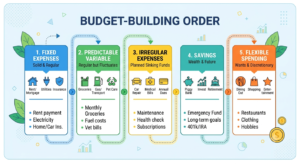
- List fixed expenses first — rent, insurance, loan payments, anything that doesn’t change month to month
- List variable-but-predictable expenses — groceries, gas, utilities that fluctuate a bit but happen every month
- Set aside irregular expenses — divide annual or occasional costs (car registration, holiday gifts, an annual subscription) by 12 and save that amount monthly, even if you don’t spend it every month
- Assign savings and debt payments — treat this like a bill, not a leftover
- Everything remaining goes to flexible spending — dining out, entertainment, hobbies
The order matters. Most failed budgets start with flexible spending and hope savings will happen with whatever’s left over. Flip that order and savings becomes the thing that’s guaranteed, not the thing that’s optional.
Step 5: Build In Slack — On Purpose
Here’s the part most budgeting advice skips: a budget with zero flexibility is a budget designed to fail.
If every dollar is precisely allocated and something unexpected comes up — and something always does — the whole system breaks and it feels like failure. Instead, build in a small buffer category, something like 5–10% of your income, labeled simply as “buffer” or “miscellaneous.” When life happens, it comes out of there instead of blowing up your grocery budget or your savings.
This single change is often the difference between a budget that survives month three and one that gets abandoned after month one.
Step 6: Track and Adjust Weekly, Not Just Monthly
A budget isn’t something you set once. It’s something you check in on.
A quick 10-minute weekly review — not a full audit, just a glance — lets you catch problems while they’re small. If you notice by week two that you’re already at 80% of your dining-out budget, you can course-correct instead of discovering it as a surprise on day 30.
Weekly check-ins also make the monthly reset far less painful. Instead of confronting a month’s worth of decisions all at once, you’re adjusting in small increments the whole way through.
Common Budgeting Mistakes to Avoid
- Copying someone else’s percentages exactly. A “healthy” housing percentage in a big city looks very different than in a small town. Use guidelines as a starting point, not gospel.
- Making the budget too detailed too fast. Twenty categories in month one usually means an abandoned budget in month two. Start broad, get more specific once the habit sticks.
- Forgetting irregular expenses exist. If you don’t plan for them monthly, they show up as “emergencies” every single time.
- Punishing yourself for going over. A budget isn’t a moral report card. Going over in one category one month is data, not a failure — use it to adjust next month’s numbers.
- Never revisiting the budget after building it. Your first draft is a starting point, not a permanent contract. Expect to adjust it for the first 2–3 months as you learn your real patterns.
A Simple Example
Say your take-home pay is $3,600 a month. Using the order from Step 4:
- Fixed expenses (rent, insurance, minimum debt payments): $1,800
- Predictable variable expenses (groceries, gas, utilities): $600
- Irregular expenses set aside (car maintenance, gifts, annual fees): $150
- Savings and extra debt payoff: $500
- Buffer: $200
- Flexible spending (dining out, entertainment, everything else): $350
Total: $3,600. Every dollar has a job, savings is locked in before spending happens, and there’s a built-in cushion for the unexpected. That’s a budget that can survive contact with a real month.
Frequently Asked Questions
How much of my income should go to savings?
A common starting target is 20%, but it depends heavily on your situation. If you’re carrying high-interest debt, prioritize paying that down first — the “savings” you get from eliminating a 22% interest rate often beats what you’d earn keeping cash in a standard savings account. Start with whatever percentage is realistic today and increase it as your income grows or expenses shrink.
What if my income changes every month?
Budget off your lowest realistic month rather than your average, and treat any income above that as a bonus to allocate — split between savings, debt, and a little flexible spending — rather than spending it in advance.
Should I budget with a spreadsheet or an app?
Whichever one you’ll actually open regularly. A spreadsheet gives more control but requires manual updates; an app usually syncs to your accounts automatically, which removes friction for a lot of people. (We compare several options in our Best Budgeting Apps for Beginners guide.)
How long does it take for a budget to actually work?
Give it 2–3 full months before judging whether it’s working. The first month is almost always inaccurate because you’re still discovering your real spending patterns — the adjustments you make in months two and three are usually what make it stick long-term.
What’s the difference between a budget and just tracking expenses?
Tracking tells you where money went. Budgeting tells money where to go before you spend it. Tracking is a useful first step (see Step 2 above), but budgeting is what actually changes outcomes.
Key Takeaways
- Build your budget from real numbers, not estimates — track before you plan
- Choose a method that matches your personality, not the one that sounds most “disciplined”
- Assign savings and debt payments before flexible spending, not after
- Build in a buffer category on purpose — a budget with zero flexibility is a budget designed to break
- Check in weekly, adjust monthly, and expect your first draft to change over the first few months
Once your monthly budget is in place, the next logical step is making sure you have a safety net for when life doesn’t go according to plan — see our guide on how to build an emergency fund step by step. And if manually tracking everything feels like too much friction, our roundup of the best budgeting apps for beginners can automate most of this process for you.
This article is for informational purposes only and is not financial advice.