
Buying your first home is one of the biggest financial decisions you will ever make. It is exciting, overwhelming, emotional, and — if you go in without the right knowledge — potentially one of the most expensive mistakes of your life.
Here’s the truth nobody tells you upfront: the home buying process is not just about finding a house you love. It is about credit scores, debt ratios, mortgage types, down payments, inspections, negotiations, closing costs, and a mountain of paperwork — all happening at the same time, often under deadline pressure.
Most first-time buyers wish they had a clear, honest roadmap before they started. That’s exactly what this guide is.
By the end of this article, you’ll understand every stage of the home buying process from start to finish — what to do, what to avoid, and exactly what to expect along the way. We’ll also point you to our detailed deep-dive guides for the topics that deserve their own full conversation. Let’s start from very beginning.
📦 QUICK ANSWER BOX
What does a first-time homebuyer need to know? First-time homebuyers need to understand the full homebuying process: checking and improving your credit score, getting mortgage pre-approval, budgeting for a down payment and closing costs, finding the right home, making an offer, passing inspection, and closing the deal. The process typically takes 3–6 months from preparation to closing. Key requirements include a credit score of at least 620 (ideally 700+), a down payment of 3–20%, and a debt-to-income ratio below 43%.
Are You Actually Ready to Buy a Home?
Before we talk about mortgages and home tours, let’s have an honest conversation about readiness — because buying too soon is one of the most costly mistakes a first-time buyer can make.
Buying a home makes financial sense when:
- ✅ You plan to stay in the area for at least 3–5 years
- ✅ Your income is stable and predictable
- ✅ Your high-interest debt is paid off or minimal [ How to Pay Off Debt Fast]
- ✅ You have a solid emergency fund still intact after the down payment [ How to Build an Emergency Fund]
- ✅ Your credit score is 620 or higher (ideally 700+) [ Credit Scores and Banking Basics]
- ✅ You can comfortably afford the monthly payment without stretching your budget dangerously thin
Buying a home may not yet make sense if:
- ❌ You might need to relocate within 2 years
- ❌ Your job or income is uncertain
- ❌ You have significant high-interest debt still outstanding
- ❌ You’d drain your entire savings just to cover the down payment
- ❌ Your credit score is below 620
This is not meant to discourage you — it’s meant to help you buy at the right time rather than just the first opportunity. A home purchase you’re financially prepared for is one of the best wealth-building moves you can make. A premature one can set you back years.
If you’re not quite ready today, use this guide as your roadmap for getting there.
Step 1: Check and Strengthen Your Credit Score
Your credit score is the single most important number in your homebuying journey — even more important than your income. It determines:
- Whether you qualify for a mortgage at all
- What interest rate you’ll be offered
- How much house you can ultimately afford
Here’s how credit score ranges typically translate to mortgage eligibility:
| Credit Score | Mortgage Eligibility | Typical Interest Rate Impact |
|---|---|---|
| 760–850 | ✅ All loan types, best rates | Lowest available rate |
| 700–759 | ✅ All loan types, competitive rates | Slightly above lowest |
| 680–699 | ✅ Most loan types, decent rates | Moderate |
| 620–679 | ⚠️ Limited to FHA/some conventional | Higher rate |
| 580–619 | ⚠️ FHA only (with 10% down) | Much higher rate |
| Below 580 | ❌ Most lenders will decline | — |
Why does this matter so much in dollar terms?
On a $300,000 mortgage over 30 years, the difference between a 6.5% rate (good credit) and an 8% rate (poor credit) is roughly $90,000 in extra interest paid over the life of the loan. That’s not a rounding error — that’s a real financial consequence of credit score neglect.
What to Do Right Now
- Pull your free credit reports from all three bureaus at AnnualCreditReport.com
- Check for errors, outdated negatives, or accounts you don’t recognize
- Pay down any credit card balances to below 30% utilization
- Make every payment on time — this is non-negotiable
- Avoid opening any new credit accounts in the 6–12 months before applying
For a complete step-by-step credit improvement plan, read our dedicated guide: How to Improve Your Credit Score
Step 2: Figure Out How Much House You Can Actually Afford
This is where most first-time buyers make their biggest mistake: letting the bank decide what they can afford.
Banks will approve you for the maximum amount they think you can technically handle. But “technically handle” and “comfortably afford while still living your life” are two very different things.
The Key Affordability Rules
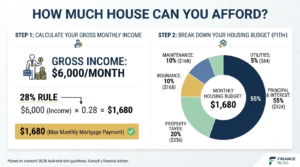
The 28% Rule: Your monthly mortgage payment (principal, interest, taxes, and insurance — known as PITI) should not exceed 28% of your gross monthly income.
The 36% Rule: Your total monthly debt payments — including your mortgage, car loans, student loans, and credit cards — should not exceed 36% of your gross monthly income. (Some lenders extend this to 43%.)
Quick Example:
- Gross monthly income: $6,000
- Maximum mortgage payment (28%): $1,680/month
- Maximum total debt (36%): $2,160/month
Beyond the mortgage payment itself, you also need to budget for:
- 🏠 Property taxes (varies by location — often $2,000–$8,000+ per year)
- 🔒 Homeowners insurance (~$1,000–$2,500/year on average)
- 🔧 Maintenance and repairs (budget 1–2% of home value per year)
- 🏊 HOA fees (if applicable — can range from $100–$1,000+/month)
- 💡 Utilities (often higher in a house vs. an apartment)
We break all of this math down in exhaustive detail — with real calculators and scenarios — in: How Much House Can You Actually Afford?
Step 3: Save for Your Down Payment (And Closing Costs)
The down payment is the upfront cash you pay toward the purchase price of the home. The rest is covered by your mortgage.
Here’s what you need to know about down payment requirements:
| Loan Type | Minimum Down Payment | Best For |
|---|---|---|
| Conventional Loan | 3–20% | Buyers with good credit (620+) |
| FHA Loan | 3.5% (credit 580+) | First-time buyers, lower credit |
| VA Loan | 0% | Eligible veterans and military |
| USDA Loan | 0% | Rural area buyers, income limits |
The PMI Factor
If you put down less than 20% on a conventional loan, you’ll be required to pay Private Mortgage Insurance (PMI) — an additional monthly fee (typically 0.5%–1.5% of the loan amount annually) that protects the lender, not you.
On a $300,000 loan, PMI could cost you $125–$375 per month on top of your mortgage payment. It’s automatically canceled once you reach 20% equity in the home, but it’s a real ongoing cost to factor in from the start.
Don’t Forget Closing Costs
This is where so many first-time buyers get blindsided. Closing costs are fees paid at the end of the transaction — typically 2–5% of the loan amount — and they are due at closing, separate from your down payment.
On a $300,000 home:
- Down payment (10%): $30,000
- Closing costs (3%): $9,000
- Total cash needed at closing: ~$39,000
We cover every closing cost line by line — and how to negotiate or minimize them — in: [Hidden Costs of Buying a Home]
For a complete strategy on building your down payment savings as fast as possible
Step 4: Get Pre-Approved for a Mortgage
Before you start looking at homes seriously, you need a mortgage pre-approval letter. This is a formal document from a lender stating how much they’re willing to lend you, based on a review of your:
- Credit score and credit report
- Income and employment history (W-2s, pay stubs, tax returns)
- Assets and bank statements
- Existing debt obligations
Pre-Qualification vs. Pre-Approval — Know the Difference
| Pre-Qualification | Pre-Approval | |
|---|---|---|
| What it is | Rough estimate based on self-reported info | Formal review of verified financial documents |
| Credit check | Soft inquiry (no score impact) | Hard inquiry (small temporary score impact) |
| Seller weight | Low — not taken seriously | High — sellers require this |
| Time to get | Minutes | 1–3 business days |
| Usefulness | Early planning only | Required to make competitive offers |
Always get a full pre-approval before house hunting. In competitive markets, sellers won’t even consider offers without one. And knowing your exact pre-approved amount prevents you from falling in love with a home outside your budget.
How to Choose a Mortgage Lender
Don’t just go with the first lender you find — or automatically with your current bank. Shop around and compare:
- Interest rate offered
- Loan origination fees
- Customer service reputation
- Loan types available (conventional, FHA, VA, USDA)
- Closing timeline
Get quotes from at least 3 different lenders. Multiple mortgage inquiries within a 14–45 day window are treated as a single inquiry by credit scoring models, so shopping around won’t significantly hurt your credit score.
Step 5: Understand Your Mortgage Options
Not all mortgages are created equal — and choosing the wrong one can cost you significantly over time.
The two most fundamental mortgage types are:
Fixed-Rate Mortgage
Your interest rate stays the same for the entire life of the loan — typically 15 or 30 years. Your monthly payment is predictable and never changes (excluding tax and insurance adjustments).
- Best for: Buyers who value stability and plan to stay long-term
- Most common term: 30-year fixed (lower monthly payment) or 15-year fixed (less interest paid overall)
Adjustable-Rate Mortgage (ARM)
Your interest rate is fixed for an initial period (commonly 5, 7, or 10 years), then adjusts periodically based on market interest rates.
- Best for: Buyers who plan to sell or refinance before the adjustment period
- Risk: If rates rise significantly at adjustment, your payment could increase substantially
This decision alone can affect your finances by tens of thousands of dollars over the life of the loan. We explain both options thoroughly — with real payment comparisons and decision frameworks — in: [ Fixed-Rate vs Adjustable-Rate Mortgage]
Step 6: Find the Right Real Estate Agent
A great buyer’s agent is one of the most underrated assets in the home buying process — especially for first-time buyers.
Here’s what many people don’t realize: as a buyer, you typically do not pay your agent’s commission. The seller traditionally covers both agents’ commissions (though this has been evolving with recent real estate industry rule changes, so confirm with your agent how compensation works in your market).
What a Good Buyer’s Agent Does For You
- Provides access to listings, including some not yet publicly available
- Schedules and attends showings with you
- Advises on fair market value and offer strategy
- Negotiates on your behalf with the seller
- Coordinates with lenders, inspectors, and closing attorneys
- Guides you through the paperwork and deadlines
- Protects your interests throughout the entire transaction
How to Find a Good Agent
- Ask for referrals from friends, family, or coworkers who recently bought
- Interview at least 2–3 agents before committing
- Look for local market expertise — someone who knows the neighborhoods you’re targeting
- Check online reviews on platforms like Zillow, Realtor.com, or Google
- Confirm they specialize in buyers (not primarily listing agents)
💡 Red Flag: An agent who pressures you to make quick decisions, discourages inspections, or seems more interested in closing than in finding the right home for you is not the right agent. Trust your gut.
Step 7: Search for Your Home — The Right Way
Now comes the part everyone thinks about first: actually looking at homes.
But before you start scrolling through Zillow at midnight falling in love with houses, get strategic.
Define Your Must-Haves vs Nice-to-Haves
Create two lists before you look at a single home:
Must-Haves (deal breakers if missing):
- Location / neighborhood / school district
- Minimum number of bedrooms and bathrooms
- Commute distance
- Specific accessibility needs
Nice-to-Haves (preferences, not requirements):
- Open floor plan
- Garage
- Finished basement
- Updated kitchen
- Large yard
Having these lists written down prevents emotional decision-making and keeps you focused when you’re standing in a beautiful home that doesn’t actually meet your needs.
New Construction vs. Existing Home
| New Construction | Existing Home | |
|---|---|---|
| Condition | Brand new, under warranty | Varies widely |
| Customization | Often possible | What you see is what you get |
| Price | Usually higher per square foot | Typically lower |
| Move-in timeline | Can be 6–18 months | 30–60 days after closing |
| Negotiation | Limited with builders | More flexible |
| Character | Modern and uniform | More unique and established |
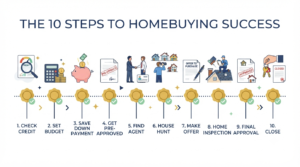
Step 8: Make an Offer and Negotiate
You’ve found the home you want. Now it’s time to make a move — strategically.
Your agent will help you craft a purchase offer, which is a formal legal document that includes:
- The price you’re offering
- Your financing details and pre-approval letter
- Earnest money deposit (typically 1–3% of purchase price, held in escrow as a show of good faith)
- Contingencies (conditions that must be met for the sale to proceed)
- Proposed closing date
- Any items you want included (appliances, fixtures, etc.)
Key Contingencies You Should Never Waive (As a First-Timer)
Financing Contingency: Protects you if your mortgage falls through — you get your earnest money back.
Inspection Contingency: Gives you the right to have the home professionally inspected and negotiate repairs or back out if serious problems are found. Never waive this as a first-time buyer.
Appraisal Contingency: Protects you if the home appraises for less than your offer price — you can renegotiate or walk away.
Negotiation Tips
- In a buyer’s market (more homes than buyers), you have leverage — offer below asking and negotiate terms
- In a seller’s market (more buyers than homes), you may need to offer at or above asking price
- Consider what matters to the seller beyond price — a flexible closing date or a quick decision can sometimes win a deal even at a slightly lower price
- Don’t get emotionally attached to any one home before you have a signed contract
Step 9: Home Inspection — Do Not Skip This
A home inspection is a professional evaluation of the property’s physical condition — roof, foundation, plumbing, electrical, HVAC, and more. It typically costs $300–$600 and takes 2–4 hours.
This is one of the best investments in the entire homebuying process.
A thorough inspection can uncover:
- Foundation cracks or structural issues
- Roof damage or end-of-life roofing
- Faulty electrical wiring (fire hazard)
- Plumbing leaks or outdated pipes
- HVAC system problems
- Water damage or mold
- Pest infestations
What Happens After the Inspection
Once you receive the inspection report, you have several options:
- Proceed as-is — if issues are minor and you’re comfortable with them
- Request repairs — ask the seller to fix specific issues before closing
- Request a price reduction — to account for repair costs you’ll handle yourself
- Request a credit at closing — seller gives you cash at closing to cover repairs
- Walk away — if major structural or safety issues are found that the seller won’t address
⚠️ Important: Don’t use your agent’s recommended inspector exclusively. Find your own independent, licensed inspector who is working for your interests.
Step 10: Final Mortgage Approval and Closing
Once your offer is accepted and the inspection is satisfactory, your mortgage enters the underwriting stage — the lender’s formal process of verifying everything one final time.
During underwriting:
- Don’t make any large purchases (new car, furniture, appliances) — this changes your debt profile
- Don’t open any new credit accounts — new inquiries can pause or cancel approval
- Don’t change jobs — employment stability is actively monitored
- Don’t move money around unexpectedly — unusual bank activity raises red flags
The lender will also order a home appraisal (typically $400–$600) to confirm the home’s market value supports the loan amount.
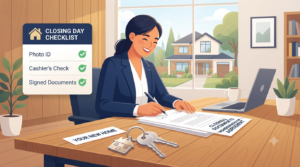
The Closing Day
Closing day is when ownership officially transfers from the seller to you. You’ll sit down with a closing attorney or title company representative and sign a significant amount of paperwork.
What you need to bring to closing:
- Government-issued photo ID
- Cashier’s check or wire transfer confirmation for closing costs and remaining down payment
- Any final documents requested by your lender
After signing, you’ll receive the keys to your new home
Common First-Time Homebuyer Mistakes
Learning from others’ mistakes is one of the most efficient things you can do. Here are the most common errors first-time buyers make:
🚫 Shopping for a home before getting pre-approved — You don’t actually know your budget until a lender tells you.
🚫 Emptying your entire savings for the down payment — You need cash reserves after closing. Aim to have 2–3 months of expenses still in your emergency fund after all homebuying costs.
🚫 Making a major financial move during the mortgage process — New debt, job changes, or large purchases can derail approval at the last minute.
🚫 Skipping the home inspection to win a bidding war — Never do this as a first-time buyer. A hidden foundation problem can cost more than the home is worth.
🚫 Buying the maximum the bank approves — The bank’s maximum and your comfortable maximum are rarely the same number.
🚫 Ignoring total ownership costs — Monthly mortgage payment is just the beginning. Factor in taxes, insurance, maintenance, utilities, and HOA fees for the real number.
🚫 Choosing a mortgage based only on interest rate — Fees, terms, and loan type matter just as much.
🚫 Not understanding what’s in your contract — Read every document. Ask your agent or attorney to explain anything you don’t understand.
First-Time Homebuyer Programs and Assistance
Many first-time buyers don’t realize they may qualify for significant financial assistance — including down payment help, reduced interest rates, and tax credits.
Federal Programs
FHA Loans — Backed by the Federal Housing Administration. Requires only 3.5% down with a 580+ credit score. More lenient qualification standards.
VA Loans — For eligible veterans, active-duty military, and surviving spouses. No down payment, no PMI, competitive rates.
USDA Loans — For buyers in eligible rural and suburban areas. No down payment required, income limits apply.
Fannie Mae Home Ready / Freddie Mac Home Possible — Conventional loans with as little as 3% down for low-to-moderate income buyers.
State and Local Programs
Almost every state has its own first-time homebuyer assistance programs — often offering:
- Down payment grants (money that doesn’t need to be repaid)
- Low-interest second mortgages for down payment help
- Closing cost assistance
- Tax credit certificates
Search “[your state] first-time homebuyer program” or visit your state’s housing finance agency website to see what’s available where you live.
💡 These programs can potentially save you thousands of dollars — but many buyers never take advantage of them simply because they don’t know they exist.
Your Complete Pre-Purchase Financial Checklist
Before you submit your first offer on any home, make sure you can check every box below:
- ☑️ Credit score reviewed and at least 620 (ideally 700+)
- ☑️ All three credit reports checked for errors
- ☑️ High-interest debt paid off or significantly reduced
- ☑️ Emergency fund intact (separate from down payment savings)
- ☑️ Down payment saved (3–20% of target price range)
- ☑️ Closing cost reserves saved (2–5% additional)
- ☑️ Budget set using the 28%/36% rule
- ☑️ Mortgage pre-approval letter in hand
- ☑️ Minimum of 3 lender quotes compared
- ☑️ Buyer’s agent selected and contracted
- ☑️ Must-have vs. nice-to-have list written down
- ☑️ Researched state/local first-time buyer programs
- ☑️ Stable employment for at least 2 years
Frequently Asked Questions (FAQ)
What credit score do I need to buy a house for the first time?
Most conventional lenders require a minimum credit score of 620, though some will go lower with compensating factors. For the best interest rates, aim for 740 or above. FHA loans accept scores as low as 580 with 3.5% down, or 500–579 with 10% down. The higher your score, the lower your interest rate — which translates to tens of thousands of dollars in savings over the loan term.
How long does the home buying process take?
From the day you start seriously preparing to the day you close, expect 3–6 months on average. This includes 1–3 months of credit improvement and savings (if needed), 1–2 weeks to get pre-approved, 1–3 months of home searching, and 30–60 days from accepted offer to closing. In competitive markets, the searching phase can take longer.
How much money do I need saved before buying a house?
You need funds for three things: your down payment (3–20% of purchase price), closing costs (2–5% of loan amount), and cash reserves (ideally 2–3 months of expenses remaining after closing). For a $300,000 home with a 10% down payment, plan on having at least $38,000–$45,000 saved — and more is always better.
Is it better to put 20% down or use a low down payment loan?
Both approaches have merit. A 20% down payment eliminates PMI and gives you a lower monthly payment and immediate equity. A low down payment (3–5%) lets you buy sooner and keep more cash on hand — but you’ll pay PMI until you reach 20% equity. The right choice depends on your timeline, savings, and local market conditions.
Should I use a real estate agent or buy on my own?
As a first-time buyer, strongly consider using a buyer’s agent. The process is complex, legally significant, and full of negotiation. An experienced agent is working exclusively for your interests and is typically paid by the seller — meaning their expertise costs you nothing directly. Going unrepresented against an experienced listing agent puts you at a significant disadvantage.
What is escrow and why does it matter?
Escrow is a neutral third-party arrangement where money and documents are held until all conditions of the sale are met. Your earnest money deposit goes into escrow when your offer is accepted. Additionally, most lenders require an escrow account for your ongoing property tax and homeowners insurance payments — a portion is collected monthly with your mortgage and paid by the lender when bills are due.
Can I buy a house with student loan debt?
Yes — having student loan debt does not automatically disqualify you from buying a home. What matters is your debt-to-income (DTI) ratio. As long as your total monthly debt payments (including student loans) stay below 36–43% of your gross monthly income, most lenders will consider you. Paying down other high-interest debt before applying can help improve your DTI.
Conclusion — Your First Home Is Within Reach
Buying your first home is not as out of reach as it might feel right now. It just requires the right preparation, the right knowledge, and the right sequence of steps.