

Introduction
Here’s something your bank will never send you an email about: the average American pays anywhere from $100 to $400 per year in completely avoidable bank fees.
That’s not a typo.
Monthly maintenance fees, overdraft fees, ATM fees, paper statement fees, wire transfer fees — banks have quietly engineered an entire ecosystem of charges designed to quietly drain money from your account, often without you even noticing.
And the worst part? Most of these fees are 100% avoidable — once you know what to look for.
This guide is your complete, no-nonsense breakdown of every major bank fee that exists, why banks charge them, and — most importantly — exactly how to make sure you never pay them again. Whether you’re just getting started with banking basics [→ see our Credit Scores and Banking Basics Pillar Guide] or you’re a seasoned account holder who suspects you’ve been overpaying for years, this article will save you real money.
Let’s dig in.
📦 QUICK ANSWER BOX (Featured Snippet Target)
What bank fees should you never pay? The bank fees you should never pay include monthly maintenance fees, overdraft fees, out-of-network ATM fees, paper statement fees, minimum balance fees, and inactivity fees. Most of these fees can be eliminated by switching to a no-fee online bank or credit union, setting up direct deposit, enabling overdraft protection, and opting into paperless statements. A few minutes of setup can save you $100–$400 every year.
Why Banks Charge So Many Fees (And Why Most Are Avoidable)
Before we get into the specific fees, it helps to understand why banks charge them in the first place.
Banks are businesses. They make money in three primary ways:
- Interest income — Charging borrowers more in interest than they pay depositors
- Investment income — Investing deposits in securities and other assets
- Fee income — Charging customers directly for account services
Fee income has become an increasingly important revenue stream for large traditional banks, particularly as low interest rate environments squeezed their margins. According to industry data, the biggest U.S. banks collectively collect billions of dollars in consumer fees every year.
Here’s the key insight: fee income is largely optional for the bank. They don’t need to charge you a $15 monthly maintenance fee to stay profitable. They charge it because they can — and because most customers either don’t notice or don’t know they have alternatives.
The good news? Competition has changed the game dramatically. Online banks and credit unions — institutions with lower overhead costs — have built entire business models around offering free or low-fee banking. Traditional banks have been forced to respond with more fee waiver options than ever before.
You have more power than you think. Let’s use it.
The 10 Bank Fees You Should Never Pay
Fee #1 — Monthly Maintenance Fees
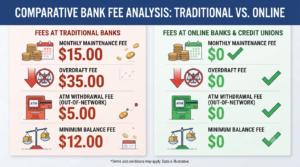
What it is: A flat fee charged every month simply for having the account open. Typically ranges from $5 to $25 per month ($60–$300/year).
Why banks charge it: It’s their baseline revenue from your account, regardless of whether you use any additional services.
Why you should never pay it: This is the single most unnecessary bank fee in existence. Dozens of banks and credit unions offer completely free checking accounts — no monthly fee, no strings attached.
How to avoid it:
- ✅ Switch to an online bank like Ally, Marcus, SoFi, or Discover — all offer fee-free checking/savings
- ✅ Join a credit union — most have no monthly maintenance fees for basic accounts
- ✅ If you stay at a traditional bank, ask about fee waiver conditions: most will waive the fee if you set up direct deposit or maintain a minimum daily balance
💡 Pro Tip: Call your bank right now and ask: “How do I get my monthly maintenance fee waived?” It costs nothing to ask, and the answer is almost always simpler than you expect.
Fee #2 — Overdraft Fees
What it is: A fee charged when you spend more money than you have in your account, and the bank covers the difference. Typically $25 to $38 per occurrence — and banks can charge this fee multiple times in a single day.
Why banks charge it: Overdraft fee revenue has historically been one of the most profitable fee categories for large banks.
Why you should never pay it: A single moment of not checking your balance can cost you $35 or more. And because overdraft fees can stack — meaning if you overdraw five transactions in one day, you can be hit with five separate fees — they can quickly spiral. Some people have woken up to find their account hundreds of dollars negative from a single afternoon of spending.
How to avoid it:
- ✅ Opt out of overdraft coverage entirely — By law (Regulation E in the US), banks must get your consent to charge overdraft fees on debit card purchases and ATM transactions. Simply call and opt out; your card will just be declined instead of overdrafting.
- ✅ Link a savings account as backup — Many banks offer free overdraft protection by automatically transferring funds from a linked savings account if your checking balance gets too low.
- ✅ Set up low-balance alerts — Get a text or app notification when your balance drops below a threshold you set (e.g., $100).
- ✅ Switch to a no-overdraft-fee bank — Many online banks and neobanks (like Chime or Current) have eliminated overdraft fees entirely, often providing small no-fee overdraft buffers.
⚠️ Important: Some banks advertise “overdraft protection” as a service you pay for monthly — this is different from the free savings account link option. You should never pay a monthly fee for overdraft protection.
Fee #3 — Out-of-Network ATM Fees
What it is: A fee charged when you use an ATM that doesn’t belong to your bank’s network. You can actually be double-charged: once by your bank and once by the ATM operator. Combined fees typically run $3 to $8 per transaction.
Why banks charge it: It’s a convenience charge — and one that adds up fast if you frequently need cash.
How to avoid it:
- ✅ Use your bank’s in-network ATMs only — Most banks have ATM locator tools in their apps
- ✅ Choose an online bank that reimburses ATM fees — Ally Bank, Charles Schwab Checking, and Aspiration all reimburse out-of-network ATM fees (some with limits, some unlimited)
- ✅ Get cash back at the grocery store or pharmacy — When you pay with your debit card, add cash back at checkout — completely free
- ✅ Use your card more, cash less — The simplest way to never pay an ATM fee is to rarely need cash
Fee #4 — Minimum Balance Fees
What it is: A fee charged when your account balance drops below a required minimum — often $500, $1,000, or even $1,500. Fee is typically $10–$25 per month.
Why banks charge it: Banks prefer deposits. Higher balances mean more money they can use for lending. The fee is designed to incentivize you to keep more money in the account — money that the bank then profits from.
Why you should never pay it: If you’re in the early stages of building your emergency fund [How to Build an Emergency Fund from Scratch], maintaining a $1,500 minimum balance in a low-interest checking account is one of the worst uses of that money. You’re essentially lending the bank your savings for free.
How to avoid it:
- ✅ Switch to an account with no minimum balance requirement
- ✅ Or meet the condition another way — often direct deposit alone will waive both the maintenance fee AND the minimum balance requirement simultaneously
- ✅ Keep a small buffer in your checking account to avoid dipping too low
Fee #5 — Paper Statement Fees
What it is: A fee charged if you prefer to receive your bank statement by mail rather than electronically. Typically $1 to $5 per month.
Why you should never pay it: This is perhaps the most easily avoidable fee on this entire list, and yet millions of people pay it every month out of habit or preference.
How to avoid it:
- ✅ Log into your online banking portal and switch to paperless/e-statements — takes less than 2 minutes
- ✅ Set a monthly reminder to review your digital statement — this takes the place of the physical copy and keeps you on top of your finances
💡 Going paperless is also better for the environment and means your statements are always searchable and accessible — even years later.
Fee #6 — Inactivity Fees (Dormancy Fees)
What it is: A fee charged if you haven’t used your account for a set period — usually 6 to 12 months. Can range from $5 to $20 per month.
Why you should never pay it: You’re literally being charged for NOT using your account. This fee most commonly hits people who open a secondary account for a specific purpose and then forget about it.
How to avoid it:
- ✅ Close accounts you no longer actively use — just make sure they have a zero balance and no pending transactions first
- ✅ If you want to keep the account open, make at least one small transaction (even a $1 transfer) every few months to reset the inactivity clock
- ✅ Set a calendar reminder twice a year to audit all your open accounts
Fee #7 — Wire Transfer Fees
What it is: A fee charged for sending money electronically from your account to another bank account — either domestically or internationally. Domestic wires typically cost $15 to $35; international wires can cost $25 to $50 or more.
Why you should never (usually) pay it: For the vast majority of personal money transfers, there are completely free alternatives that have made wire transfers nearly obsolete for everyday use.
How to avoid it:
- ✅ Use Zelle (built into most major bank apps, free, and near-instant for domestic transfers)
- ✅ Use Venmo, PayPal, or Cash App for personal payments (free for standard transfers)
- ✅ Use ACH bank transfers — these are free at most banks and credit unions, just slightly slower (1–3 business days)
- ✅ For international transfers, use Wise (formerly TransferWise) or Remitly — dramatically cheaper than bank wire fees
Fee #8 — Foreign Transaction Fees
What it is: A fee charged when you make a purchase in a foreign currency or from a foreign merchant. Typically 1% to 3% of every transaction.
Why it matters: If you travel internationally and put $3,000 of trip expenses on a card with a 3% foreign transaction fee, you just paid an extra $90 for nothing.
How to avoid it:
- ✅ Get a no-foreign-transaction-fee credit card before you travel — many travel rewards cards (like Chase Sapphire, Capital One Venture, and Schwab Investor Card) charge zero foreign transaction fees
- ✅ Use Charles Schwab Checking abroad — it reimburses ALL ATM fees worldwide and has no foreign transaction fees, making it arguably the best travel debit card available
- ✅ Never use airport currency exchange kiosks — they charge some of the worst rates and fees available anywhere
Fee #9 — Returned Item / Bounced Check Fees (NSF Fees)
What it is: An NSF (Non-Sufficient Funds) fee is charged when a payment — like a check, automatic bill payment, or ACH transfer — is returned unpaid because your account didn’t have enough money. Typically $25 to $36 per returned item.
The double pain: Unlike overdraft fees (where the bank pays the transaction and charges you), NSF fees mean your payment was rejected AND you pay a fee. So the bill you were trying to pay still isn’t paid — potentially triggering a late fee from the biller on top of the NSF fee from your bank.
How to avoid it:
- ✅ Keep a small buffer — even $100 to $200 extra in your checking account at all times as a safety cushion
- ✅ Use the low-balance alerts mentioned in the overdraft section
- ✅ Review your automatic payments schedule and make sure your account is funded before each one hits
- ✅ Build your emergency fund [→ Article #7] so you’re never just barely scraping by in your checking account
Fee #10 — Excessive Transaction Fees (Savings Account Withdrawal Limits)
What it is: Historically under Federal Reserve Regulation D, banks limited savings account withdrawals to 6 per month. Although the Fed suspended this rule in 2020, many banks still enforce the limit and charge $5 to $15 per excess transaction.
How to avoid it:
- ✅ Check whether your bank still enforces this limit
- ✅ Use your checking account for all regular spending and only transfer from savings when genuinely needed
- ✅ If you’re frequently transferring out of savings, consider whether you actually need more in checking — revisit your budget [→ Article #1: Complete Beginner’s Guide to Personal Budgeting]
The True Annual Cost of Bank Fees — A Reality Check
Let’s put these numbers together with a realistic scenario. Meet Jordan, a 28-year-old with a standard traditional bank account:
| Fee Jordan Pays | Frequency | Annual Cost |
|---|---|---|
| Monthly maintenance fee ($12) | 12x/year | $144 |
| Overdraft fees ($35) | 4x/year | $140 |
| Out-of-network ATM fees ($4.50) | 2x/month | $108 |
| Paper statement fee ($3) | 12x/year | $36 |
| 1 wire transfer | 1x/year | $25 |
| TOTAL ANNUAL FEES | $453 |
Now meet Alex, who took 30 minutes to switch to an online bank and adjust their settings:
| Fee Alex Pays | Frequency | Annual Cost |
|---|---|---|
| Monthly maintenance fee | $0 | $0 |
| Overdraft fees | $0 (opted out + low-balance alerts) | $0 |
| ATM fees | $0 (ATM fee reimbursement) | $0 |
| Paper statement fee | $0 (paperless) | $0 |
| Wire transfers | $0 (uses Zelle/ACH) | $0 |
| TOTAL ANNUAL FEES | $0 |
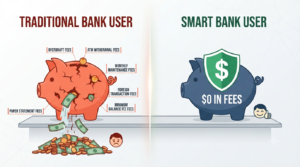
The difference: $453 per year. Over 10 years, that’s $4,530 — enough for a vacation, a significant investment contribution, or a solid boost to an emergency fund.
This isn’t hypothetical. This is the real financial impact of fee awareness.
How to Choose a No-Fee Bank Account — What to Look For
Now that you know what fees to avoid, here’s exactly what to look for when choosing a better banking option:
Checklist — No-Fee Bank Account Requirements
Use this checklist when evaluating any bank or credit union:
- ☑️ No monthly maintenance fee — or easy-to-meet waiver conditions (like direct deposit)
- ☑️ No minimum balance requirement — or a minimum you can easily maintain ($0–$100)
- ☑️ No overdraft fees — or a clear, free overdraft alternative
- ☑️ Large ATM network — or ATM fee reimbursement
- ☑️ FDIC or NCUA insured — non-negotiable for safety
- ☑️ Mobile app with alert features — for real-time spending visibility
- ☑️ Competitive savings rate — especially if you’re keeping savings in the same institution
Best Types of Banks for Fee-Free Banking
| Bank Type | Best For | Fee Risk |
|---|---|---|
| Online Banks (Ally, Discover, SoFi) | Overall low fees + high savings rates | Very Low ✅ |
| Credit Unions | Community members, personalized service | Very Low ✅ |
| Neobanks (Chime, Current) | Beginners, those rebuilding banking history | Low ✅ |
| Large Traditional Banks | Branch access, complex banking needs | High ⚠️ |
| Community Banks | Local relationships, small business | Medium ⚡ |
For a deep-dive comparison of where to keep your money, see our related guide: [Checking vs. Savings Account: What’s the Difference? ]
How to Negotiate or Get Fees Refunded at Your Current Bank
What if you’re not ready to switch banks — or you love your current institution but hate the fees? Here’s something most bank customers don’t know:
Banks will often refund fees if you simply ask.
This works particularly well if you:
- Are a long-standing customer (2+ years)
- Don’t have a history of fee refund requests
- Have multiple accounts or products with the bank
- Call during non-peak hours and speak politely with a representative
The Exact Script to Use When Calling Your Bank
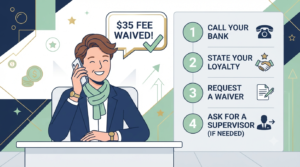
Here’s a real-world conversation framework that works:
“Hi, my name is [Name] and I’ve been a customer for [X years]. I noticed a [$35] overdraft fee on my account from [date]. I’ve been a loyal customer and this isn’t something that happens often for me. I was hoping you might be able to waive that fee as a courtesy. Is that something you can help me with?”
Success rate: Surprisingly high — many bank representatives have the authority to waive one or two fees per year per customer as a goodwill gesture. You literally have nothing to lose by asking. The worst they can say is no.
If the first representative says no, politely ask: “Is there a supervisor or someone else I could speak to about this?”
Red Flags — Signs Your Bank Is Taking Advantage of You
Beyond individual fees, here are broader warning signs that your banking relationship may not be working in your favor:
🚩 Your savings account earns 0.01% APY — The national average for online banks is dramatically higher. If your savings is stagnant, move it. [→ Article #6: Best High-Yield Savings Accounts in 2026]
🚩 You can’t find your fee schedule easily — Reputable banks are transparent about fees. If they’re buried in fine print or hard to find, that’s intentional.
🚩 You’re charged for using a human teller — Yes, some banks charge fees for in-person transactions. That’s a firm reason to leave.
🚩 Customer service is difficult to reach — Good banks make it easy to get help. If you’re on hold for 45 minutes every time you call, your bank doesn’t respect your time.
🚩 They auto-enrolled you in a fee-based service — Some banks quietly enroll customers in paid overdraft protection, credit monitoring, or other subscription-style services. Review your account statement line by line at least twice a year.
🚩 Your fees have increased and you weren’t notified — Banks are required to notify customers of fee changes, but the notifications are often buried in emails or mailings. Always read bank correspondence.
Your 15-Minute Bank Fee Audit — Do This Today
You don’t need to spend hours on this. Set a 15-minute timer right now and do the following:
Step 1 (3 minutes): Log into your online banking and pull up your last 3 months of statements.
Step 2 (5 minutes): Search for the following words in your transactions: “fee,” “charge,” “service charge,” “overdraft,” “ATM.” Write down every fee you find and the total amount.
Step 3 (3 minutes): Visit your bank’s website and find their current fee schedule. Compare what they’re charging to what you found in Step 2. Confirm you understand every fee.
Step 4 (4 minutes): Decide on your action plan:
- Can the fee be avoided by changing a setting? → Fix it now.
- Can the fee be waived by calling? → Schedule a call this week.
- Is the fee completely unavoidable at this bank? → Start researching alternatives.
That’s it. 15 minutes could recover hundreds of dollars per year.
Understanding where your money is going is a core part of building real financial health — and it connects directly to the budgeting habits we cover in [: Complete Beginner’s Guide to Personal Budgeting] and the savings strategies in [ How to Save Money Fast].
Frequently Asked Questions (FAQ)
Can banks legally charge any fee they want?
Banks can charge most fees they choose, as long as they disclose them clearly in your account agreement. However, certain protections exist — for example, under Regulation E, banks must get your explicit consent before enrolling you in overdraft coverage for debit card and ATM transactions. The CFPB (Consumer Financial Protection Bureau) also oversees unfair, deceptive, or abusive banking practices. Always read the fee disclosure when opening any account.
What is the best bank with no fees?
Several excellent no-fee options exist in 2026, including Ally Bank (no maintenance fees, ATM reimbursement), Discover Bank (no fees on checking, cashback debit), SoFi (no fees, early direct deposit, high-yield savings), Chime (no fees, no overdraft on qualifying accounts), and most local credit unions. The best one depends on your specific needs — branch access, ATM network, savings rate, and features.
Do credit unions have fewer fees than banks?
Generally, yes. Because credit unions are member-owned and nonprofit, their goal is to serve members rather than maximize profit. This typically translates into lower fees, better loan rates, and higher savings rates compared to large commercial banks. The tradeoff is usually fewer branch locations and sometimes less advanced technology platforms.
Will switching banks hurt my credit score?
No — opening or closing a standard bank account (checking or savings) does not affect your FICO credit score. Banks use a separate system called ChexSystems to screen new account applicants, not your credit report. However, if your account is sent to collections due to an unpaid negative balance, THAT can eventually appear on your credit report. To learn more about credit scores, see [Article #27: How Credit Scores Work].
What if I have a negative ChexSystems record — can I still open a bank account?
Yes. If you have a negative ChexSystems record (from a past account with unpaid fees or negative balance), many banks and credit unions offer “second chance” checking accounts specifically designed for people in this situation. They often come with some restrictions but allow you to rebuild your banking history. Neobanks like Chime and Current are also known for being more accessible to those with ChexSystems records.
Is it worth switching banks just to avoid fees?
Absolutely. The math is simple: if you’re paying $200–$400 per year in avoidable fees at a traditional bank, switching to a no-fee online bank takes about 30–60 minutes of your time and pays immediate dividends. The hardest part for most people is updating direct deposit and automatic payments — but even that process typically takes less than a week.
What is the overdraft fee rule change I’ve been hearing about?
The CFPB has been actively pursuing regulations to significantly cap or limit overdraft fees at large banks. Some major banks, anticipating regulatory pressure, voluntarily reduced overdraft fees or eliminated them in recent years. The regulatory landscape around overdraft fees has been evolving rapidly — it’s worth checking the current rules at your specific institution, as policies vary significantly between banks.
Conclusion — Stop Funding Your Bank’s Profits With Your Own Money
Bank fees are not inevitable. They are not a cost of doing business. They are optional charges that banks count on customers not noticing, not questioning, and not avoiding.
But now you know better.
Here’s what to take away from this guide:
- ✅ The 10 most common bank fees — monthly maintenance, overdraft, ATM, minimum balance, paper statements, inactivity, wire transfers, foreign transactions, NSF, and excess withdrawal fees
- ✅ Every single one has a free or lower-cost alternative
- ✅ The average American pays $100–$400+ per year in unnecessary fees
- ✅ Switching to an online bank or credit union is the single most impactful move
- ✅ You can negotiate refunds on past fees by calling and asking politely
- ✅ A 15-minute audit of your statements right now could recover money immediately
Fee awareness is just one piece of the larger financial picture. Once your banking costs are under control, your next steps are building your credit score [How to Improve Your Credit Score in 6 Months] and making sure your savings are actually working for you And if you haven’t read the full banking foundation guide yet, start there: [ Credit Scores and Banking Basics — A Beginner’s Complete Guide]
Your money is yours. Keep more of it.