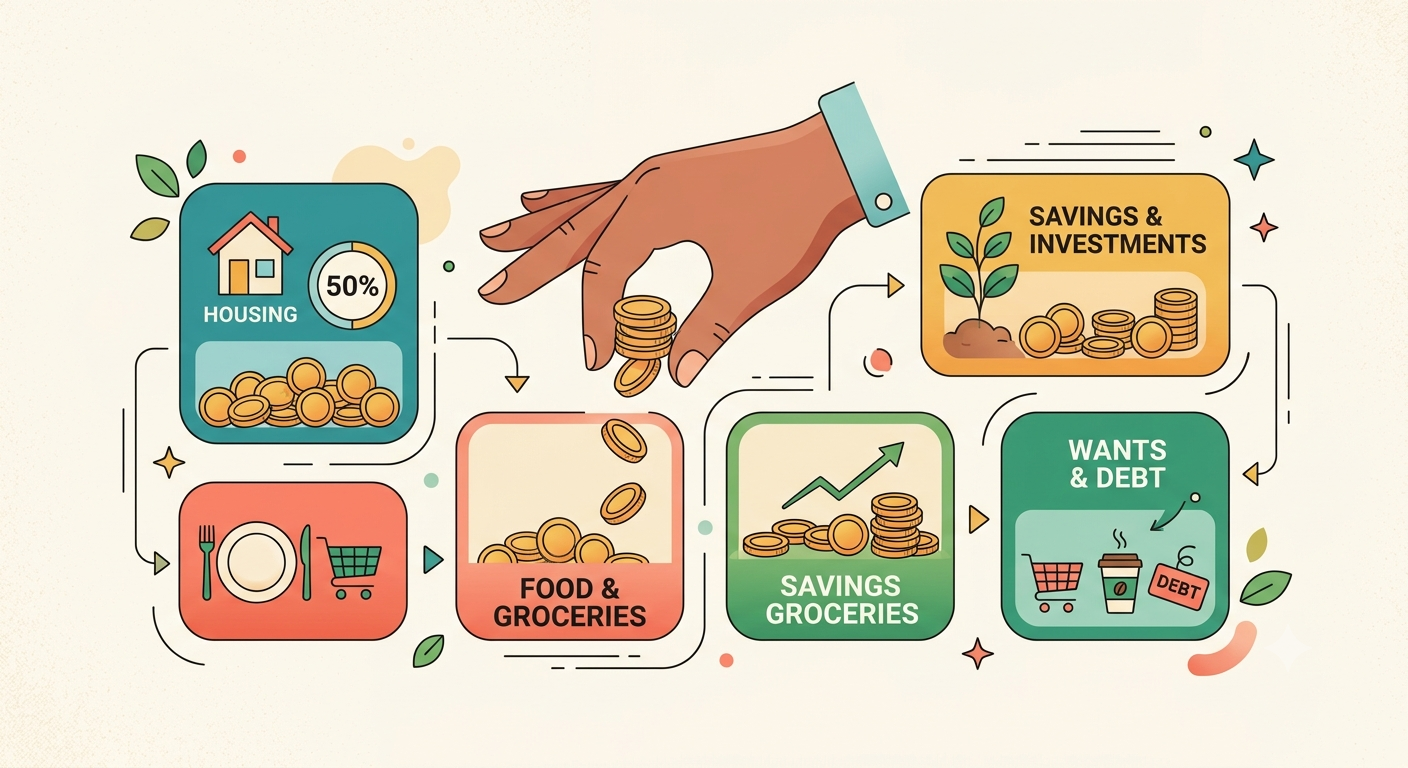
If you’ve ever searched “how do I start budgeting” and felt overwhelmed by category-heavy spreadsheets and twenty-line templates, the 50/30/20 rule is probably the first method you should try. It’s not the most precise system out there, and it’s not going to micromanage your coffee spending. What it will do is give you three simple buckets, a rough percentage for each, and enough structure to stop wondering where your paycheck went.
This guide breaks down exactly how the rule works, walks through real income examples at different pay levels, and — just as importantly — covers when it doesn’t fit your situation, because no single budgeting method is right for everyone.
(This article is part of our Complete Beginner’s Guide to Budgeting and Saving Money — if you haven’t read the full guide yet, it’s a good place to start before diving into the details below.)
What Is the 50/30/20 Rule?
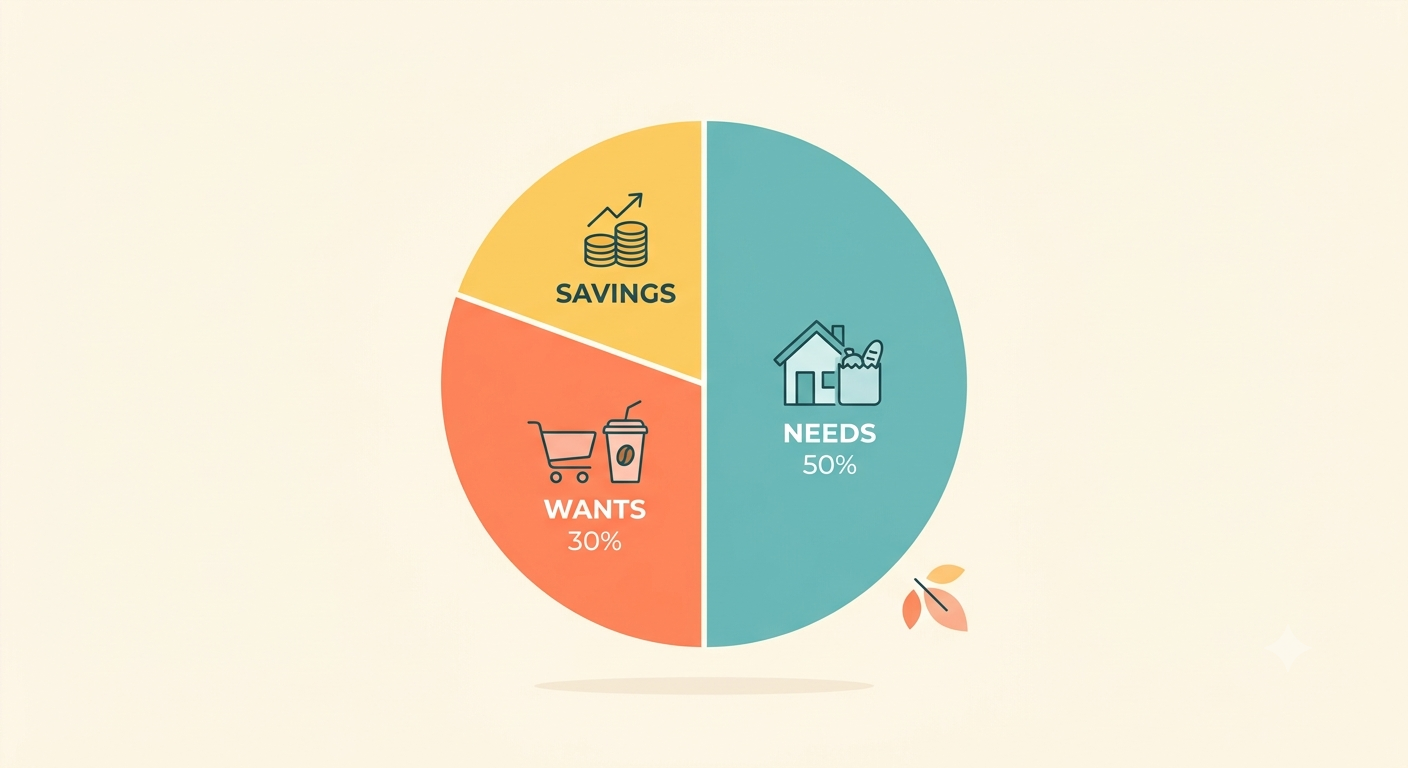
The 50/30/20 rule is a simple budgeting framework that splits your after-tax income into three categories:
- 50% for needs — the expenses you genuinely can’t avoid: rent or mortgage, groceries, utilities, insurance, minimum debt payments, transportation to work
- 30% for wants — the things that make life enjoyable but aren’t strictly necessary: dining out, streaming subscriptions, hobbies, travel, shopping
- 20% for savings and debt payoff — building an emergency fund, contributing to retirement, or paying extra toward debt beyond the minimum
The concept was popularized by U.S. Senator Elizabeth Warren and her daughter Amelia Warren Tyagi in their book on family finances, and it’s stuck around for one reason: it’s genuinely easy to remember and apply. You don’t need to track twenty categories or set up a complicated spreadsheet. You just need three numbers.
That simplicity is exactly why it works so well for beginners — and exactly why it eventually stops being precise enough for people with more complex finances. We’ll get to both sides of that.
How to Calculate Your 50/30/20 Budget
Start with your after-tax income — what actually lands in your bank account, not your gross salary before deductions. This is an important distinction, because budgeting off your gross pay means you’re planning with money you’ll never actually see.
Once you know your take-home pay, the math is simple:
- Multiply your monthly take-home income by 0.50 to get your needs budget
- Multiply it by 0.30 to get your wants budget
- Multiply it by 0.20 to get your savings and debt payoff budget
If your income varies month to month — freelance work, tips, commission — use your average income from the last three to six months, or lean toward your lowest realistic month so you’re not budgeting off a best-case scenario. (Our guide on budgeting on irregular income covers this in more depth if that applies to you.)

Real Income Examples
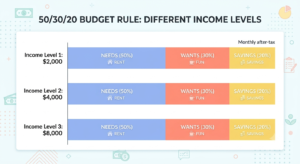
Numbers are easier to understand in context, so here’s how the 50/30/20 split looks at three different income levels. These are illustrative examples — your actual needs percentage will vary based on where you live and your personal circumstances.
Example 1: $2,800/month take-home pay
- Needs (50%): $1,400
- Wants (30%): $840
- Savings/debt (20%): $560
At this income level, needs often eat up more than 50% in higher cost-of-living areas, which is worth watching closely. If rent alone is $1,200, you’re already close to the full needs budget before groceries or utilities are even factored in.
Example 2: $4,500/month take-home pay
- Needs (50%): $2,250
- Wants (30%): $1,350
- Savings/debt (20%): $900
This is often the income range where the 50/30/20 rule feels most natural to apply, since there’s usually enough breathing room in the “wants” category without needs completely dominating the budget.
Example 3: $7,000/month take-home pay
- Needs (50%): $3,500
- Wants (30%): $2,100
- Savings/debt (20%): $1,400
At higher income levels, many people find the 20% savings target actually feels too low — their needs cost far less than 50% of their income, which frees up room to push savings closer to 30% or more. There’s nothing wrong with adjusting the ratio once your basic needs are comfortably covered.
What Counts as a “Need” vs. a “Want”?
This is where the 50/30/20 rule gets genuinely tricky, because the line between needs and wants isn’t always obvious — and being honest with yourself here matters more than getting the percentages exactly right.
Clear needs: rent or mortgage, minimum loan and credit card payments, groceries (the actual staples, not takeout), basic utilities, insurance premiums, transportation required to get to work.
Clear wants: subscription streaming services, dining out, new clothes beyond basic necessity, hobbies, entertainment, upgraded versions of things you already own.
The gray area: this is where most people get stuck. Is your phone plan a need or a want? Probably a need, but the premium unlimited plan with extra features might be a want. Is your car payment a need? If you need it to get to work and there’s no reasonable alternative, yes — but the difference between a reliable used car payment and a brand-new luxury vehicle payment is largely a want dressed up as a need.
A useful test: ask whether a cheaper version of this expense would still meet the actual underlying need. If yes, the gap between the cheap version and what you’re actually paying is really a “want,” even if the category feels essential.
Pros of the 50/30/20 Rule
It’s simple enough to actually stick with. You don’t need twenty categories or a finance degree to use it. Three buckets and two multiplications is the entire system.
It builds in savings automatically. Unlike budgets that treat savings as “whatever’s left over,” the 50/30/20 rule assigns savings a fixed percentage from the start, which means it actually happens instead of getting pushed aside by month-end spending.
It allows for genuine enjoyment. The 30% “wants” category isn’t a guilt trip — it’s a built-in acknowledgment that life shouldn’t be 100% needs and savings with zero room for things you enjoy.
It works as a diagnostic tool even if you don’t follow it exactly. Even people who eventually move to a more detailed system often use the 50/30/20 split as a first check: “Am I roughly in the right zone, or is one category wildly out of balance?”
Cons of the 50/30/20 Rule
It doesn’t work well in high cost-of-living areas. If rent alone eats 45–55% of your income, the “needs” category becomes unrealistic before you’ve even added groceries or utilities. This is the single most common reason the rule breaks down for people in expensive cities.
It’s not precise enough for detailed goals. If you’re aggressively paying off debt, saving for a house down payment, or trying to hit a specific retirement number, a flat 20% might not be aggressive enough — or might not tell you exactly where to trim.
The needs-vs-wants line is genuinely blurry. As covered above, plenty of expenses sit in a gray area, which means two people using the “same” method can categorize things completely differently.
It doesn’t account for irregular expenses well. Annual costs like car registration or holiday spending don’t fit neatly into a monthly percentage unless you plan for them separately. (Our guide on sinking funds covers exactly how to handle this gap.)

What If the Percentages Don’t Fit Your Life?
This is the most important section of this entire guide, because the 50/30/20 rule is a starting framework, not a law. If your needs genuinely require 65% of your income because you live somewhere expensive, forcing the numbers to fit 50% isn’t discipline — it’s just setting yourself up to fail on paper before the month even starts.
A more realistic approach for a lot of people looks like this:
- Calculate your actual needs first, honestly, without forcing them into 50%
- If needs come in higher than 50%, adjust wants downward rather than pretending the gap doesn’t exist
- Protect the savings percentage as much as possible, even if it means starting smaller than 20% and building up over time
- Revisit the split every few months as your income or expenses change
The percentages are a guideline for balance, not a rigid contract. If you find yourself needing 55/25/20 or 45/25/30, that’s not a failure of the method — that’s the method doing exactly what it’s supposed to do: giving you a framework to build your own numbers around.
50/30/20 vs. Other Budgeting Methods
The 50/30/20 rule is one of several popular approaches, and it’s worth knowing where it fits relative to the others so you can decide if it’s really the right starting point for you.
Compared to zero-based budgeting, which assigns every single dollar a specific job down to the last cent, the 50/30/20 rule is far less detailed — which is either a strength or a weakness depending on whether you find detailed tracking motivating or exhausting. See our full zero-based budgeting guide for a side-by-side look.
Compared to the cash envelope system, which physically limits spending by category, the 50/30/20 rule is more flexible but relies more heavily on self-discipline, since there’s no hard stop once a category runs low.
If you’re not sure which approach fits your personality best, our guide comparing the best budgeting methods walks through all the major options side by side, including who each one tends to work best for.
How to Actually Start Using It This Month
Putting the 50/30/20 rule into practice doesn’t require anything complicated:
- Calculate your after-tax monthly income
- Multiply by 0.50, 0.30, and 0.20 to get your three target numbers
- Track your spending for the first month against those three buckets (a simple app or spreadsheet works fine — see our roundup of the best free budgeting apps if you want something automated)
- At the end of the month, compare your actual spending to the targets
- Adjust the percentages slightly if needed, based on what you learned, and repeat
Expect the first month to be somewhat inaccurate. That’s normal — you’re not failing the system, you’re calibrating it to your real life. Most people need two or three months before the numbers start to genuinely reflect how they actually spend.

Frequently Asked Questions
Is the 50/30/20 rule based on gross or net income? Net income — what actually lands in your bank account after taxes and deductions. Budgeting off your gross salary means planning with money you’ll never actually have available to spend.
What if my needs are more than 50% of my income? This is extremely common, especially in higher cost-of-living areas. Rather than forcing an unrealistic split, adjust the wants percentage down and try to protect savings as much as possible, even if it starts smaller than 20%.
Is 20% savings enough? It’s a reasonable starting target, but not a universal rule. If you’re carrying high-interest debt, prioritizing extra payments there often makes more financial sense than parking the same money in low-interest savings. If your needs are comfortably under 50%, pushing savings higher than 20% is a smart move rather than a requirement to avoid.
Does the 50/30/20 rule account for debt payoff? Yes — debt payments beyond the minimum typically fall into the 20% “savings and debt” category, while minimum required payments count as a “need,” since they’re not optional.
How is this different from just tracking my expenses? Tracking tells you where your money went after the fact. The 50/30/20 rule tells your money where to go before you spend it, using three simple targets instead of dozens of granular categories.
Key Takeaways
- The 50/30/20 rule splits after-tax income into 50% needs, 30% wants, and 20% savings and debt payoff
- It’s one of the simplest budgeting methods to start with, especially for beginners
- The needs-vs-wants line is often blurrier than it seems — be honest rather than technically correct
- The percentages are a flexible starting guideline, not a rigid rule — adjust them to fit your actual cost of living
- It works well as a first framework, but people with more complex financial goals often outgrow it in favor of more detailed methods
If the 50/30/20 split feels too loose for your situation, our guide to zero-based budgeting offers a more detailed alternative where every dollar gets a specific job. And if you’re still deciding which method fits your life best, our full comparison of budgeting methods is the fastest way to figure that out.
This article is for informational purposes only and is not financial advice.