
If you’ve got more than one debt — a credit card, a personal loan, maybe a buy-now-pay-later balance — you’ve probably run into two competing pieces of advice. One camp says pay off your smallest debt first. The other says attack the debt with the highest interest rate. Both can’t be the “best” method, right?
Actually, they can. They’re just optimizing for different things. This guide breaks down exactly how the debt snowball and debt avalanche methods work, runs real numbers so you can see the difference in dollars, and helps you figure out which one you’ll actually stick with — because the method you abandon in month three is the worst method of all.
This article is part of our complete guide to getting out of debt. If you haven’t mapped out your full debt payoff plan yet, start there.

What Is the Debt Snowball Method?
The debt snowball method has you pay off debts in order from smallest balance to largest, regardless of interest rate.
Here’s how it works:
- List all your debts from smallest balance to largest.
- Make minimum payments on everything except the smallest debt.
- Throw every extra dollar you can at that smallest debt until it’s gone.
- Once it’s paid off, take the amount you were paying on it and add it to the minimum payment on the next-smallest debt.
- Repeat until every debt is paid off.
The name comes from the snowball effect — as each debt disappears, the amount you’re putting toward the next one grows, so your payoff picks up speed the same way a snowball rolling downhill gets bigger and faster.
This method was popularized by financial personality Dave Ramsey, and its main selling point isn’t math — it’s momentum. Knocking out a full debt, even a small one, gives you a visible win early on.
What Is the Debt Avalanche Method?
The debt avalanche method has you pay off debts in order from highest interest rate to lowest, regardless of balance size.
Here’s how it works:
- List all your debts from highest interest rate (APR) to lowest.
- Make minimum payments on everything except the debt with the highest rate.
- Put every extra dollar toward that highest-rate debt until it’s gone.
- Roll that payment into the next-highest-rate debt.
- Repeat until every debt is paid off.
Because you’re targeting the debt that’s costing you the most in interest first, this method minimizes the total interest you pay over the life of your payoff plan. Mathematically, it’s the more efficient option — always.
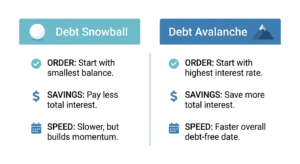
Debt Snowball vs. Debt Avalanche: Side-by-Side Comparison
| Factor | Debt Snowball | Debt Avalanche |
|---|---|---|
| Payoff order | Smallest balance first | Highest interest rate first |
| Best for | Motivation and momentum | Saving the most money |
| Total interest paid | Usually higher | Usually lower |
| Time to first “win” | Faster (small debt clears quickly) | Slower (if highest-rate debt is also large) |
| Math efficiency | Lower | Higher |
| Psychological reward | Higher, more frequent | Lower, more delayed |
| Best suited for | People who need visible progress to stay motivated | People who are disciplined and focused purely on cost |
A Real Numbers Example
Let’s say you have three debts and $200 extra per month to put toward payoff on top of minimums.
- Credit Card A: $1,200 balance, 24% APR, $35 minimum
- Personal Loan: $4,500 balance, 12% APR, $120 minimum
- Credit Card B: $2,800 balance, 19% APR, $70 minimum
With the snowball method, you’d order these by balance: Credit Card A ($1,200) → Credit Card B ($2,800) → Personal Loan ($4,500). You’d clear Credit Card A first, likely within a few months, which feels great — but you’re leaving the 19% and 24% APR debts partially untouched while paying down the lowest-rate loan later in the sequence.
With the avalanche method, you’d order these by rate: Credit Card A (24%) → Credit Card B (19%) → Personal Loan (12%). You’d also start with Credit Card A here, since it happens to be both the smallest balance and the highest rate — a common overlap that makes the two methods agree at the start more often than people expect. After that, though, avalanche moves to Credit Card B before touching the personal loan, cutting off the more expensive interest sooner.
In this particular example, the two methods start the same way, but in cases where your smallest debt isn’t your highest-rate debt, the avalanche method typically saves you somewhere between a few hundred and a few thousand dollars in interest, depending on your balances, rates, and how long payoff takes. The exact savings depends entirely on your specific numbers — which is why it’s worth listing out your own debts before deciding.
Related: Personal Loans Explained: How They Work and When to Use One if one of your debts is a loan you’re considering consolidating.
So Which One Actually Pays Off Debt Faster?
This is where people get tripped up. “Faster” can mean two different things:
- Faster to see a debt disappear → Snowball wins, almost always, because you’re targeting the smallest number.
- Faster to be completely debt-free while paying the least amount of money → Avalanche wins, because less of your payment is being eaten by interest along the way, which means more of it goes toward principal.
If your debts all carry similar interest rates, the difference between the two methods shrinks to almost nothing — in that case, go with whichever order motivates you more. The gap only becomes meaningful when your interest rates vary a lot from debt to debt, especially when a high-balance debt also carries a high rate.

Which Method Should You Actually Choose?
Here’s the honest answer: the best method is the one you’ll stick with until every debt is gone.
Consider the debt snowball if:
- You’ve tried budgeting or debt payoff before and lost motivation partway through.
- You have several small debts and one or two larger ones.
- You need quick wins to feel like progress is real.
- You tend to give up on long financial plans that don’t show results fast.
Consider the debt avalanche if:
- You’re mainly trying to minimize what you pay in total.
- Your interest rates vary significantly between debts (for example, a 24% credit card next to a 7% loan).
- You’re naturally disciplined about sticking to a plan even without early rewards.
- You’ve already built the habit of consistent payments and don’t need motivational boosts.
Some people also use a hybrid approach: start with one small “quick win” debt using the snowball method for early motivation, then switch to avalanche order for the rest. There’s no rule that says you have to pick one method and follow it rigidly — the only real rule is consistency.
A Quick Note on Minimum Payments
Regardless of which method you choose, never skip minimum payments on your other debts while focusing extra money on one. Missing minimums can trigger late fees, damage your credit score, and in some cases increase your interest rate through penalty APRs. Snowball and avalanche both assume you’re paying at least the minimum on everything — the “extra” money is what moves between debts, not the baseline payments themselves.
If you’re struggling to keep up with minimum payments at all, it may be worth reading about how to negotiate directly with your creditors before committing to either payoff strategy.
Frequently Asked Questions
Does the debt snowball method really work? Yes, for many people it works better in practice than the mathematically optimal avalanche method, simply because behavioral consistency matters more than theoretical efficiency. A perfect plan you abandon saves you nothing.
Can I switch between snowball and avalanche partway through? Yes. Some people start with snowball for motivation and switch to avalanche once they’ve built momentum, or vice versa. What matters most is that you keep making consistent extra payments.
Does either method affect my credit score differently? Not directly. Your credit score responds to on-time payments and your credit utilization ratio, not to which order you pay off debts. Either method, followed consistently, tends to improve your score over time as balances drop.
What if all my debts have similar interest rates? Then the snowball and avalanche methods will produce very similar results in terms of total interest paid, so you should default to whichever order keeps you most motivated — usually the snowball.
The Bottom Line
The debt avalanche method will save you more money in a spreadsheet. The debt snowball method will often keep you paying down debt in real life. Neither is wrong — they’re built for different problems. If you’re unsure which one fits you, start by listing your debts with balances and interest rates side by side, then be honest with yourself about whether you need quick wins to stay motivated or whether you can play the long game without them.
Once you’ve chosen a method, the most important step is simply starting — and sticking with it, one payment at a time.
Next in this series: Student Loan Repayment Options You Need to Know — if student loans are part of your debt mix, this covers repayment plans specific to them.