Student loan repayment isn’t one-size-fits-all. Federal borrowers alone can choose from half a dozen repayment plans, each built for a different income level, career path, or payoff timeline — and picking the wrong one can mean paying thousands more in interest, or missing out on forgiveness you’d otherwise qualify for.
This guide breaks down the main student loan repayment options, who each one fits best, and how to decide which plan actually matches your situation.
Part of our complete guide to getting out of debt. If you’re weighing debt payoff order across multiple debts, see debt snowball vs. debt avalanche first.
Table of Contents
- Federal vs. Private Student Loans
- Standard Repayment Plan
- Graduated Repayment Plan
- Extended Repayment Plan
- Income-Driven Repayment Plans
- Refinancing Your Student Loans
- How to Choose the Right Plan
- FAQ
Federal vs. Private Student Loans: Why It Matters First {#federal-vs-private}
Before comparing repayment plans, know which type of loan you have — it determines which options are even available to you.
- Federal student loans are issued by the U.S. Department of Education and come with access to standardized repayment plans, income-driven options, deferment, forbearance, and forgiveness programs.
- Private student loans are issued by banks, credit unions, or online lenders. They typically don’t offer income-driven plans or forgiveness, though some lenders provide their own hardship options or refinancing.
Key takeaway: federal loans give you far more built-in flexibility. If you’re not sure which type you have, check your loan servicer’s portal or the National Student Loan Data System.
Standard Repayment Plan {#standard-plan}
The standard repayment plan is the default option for federal loans: fixed monthly payments over 10 years, calculated to pay off your balance completely by the end of the term.
Best for: borrowers who can comfortably afford the fixed payment and want to minimize total interest paid, since this plan pays off the loan fastest among federal options.
Trade-off: monthly payments are higher than other federal plans, which can strain a tight budget, especially early in a career.
Graduated Repayment Plan {#graduated-plan}
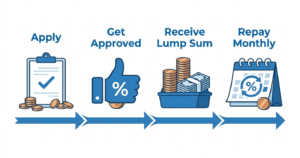
The graduated repayment plan starts with lower monthly payments that increase every two years, still paying off the loan within 10 years.
Best for: borrowers who expect their income to rise steadily, such as those early in a career with strong growth potential.
Trade-off: because payments start low, more interest accrues early on, so you’ll pay more in total interest than under the standard plan.
Extended Repayment Plan {#extended-plan}
The extended repayment plan stretches payments over up to 25 years, either at a fixed or graduated payment structure, lowering the monthly amount significantly.
Best for: borrowers with larger loan balances (typically over $30,000) who need meaningfully lower monthly payments and can accept a longer payoff timeline.
Trade-off: the extended term means substantially more total interest paid over the life of the loan compared to the 10-year standard plan.
Income-Driven Repayment (IDR) Plans {#idr-plans}
Income-driven repayment plans cap your monthly payment at a percentage of your discretionary income, recalculated annually based on your income and family size. After 20–25 years of qualifying payments, any remaining balance may be forgiven (though forgiven amounts can be taxable, depending on current law).
Several IDR plans exist, with different names and percentage formulas — the specifics have changed over time due to policy and legal developments, so check the Federal Student Aid website (studentaid.gov) for the current plans and formulas available to you.
Best for: borrowers with high loan balances relative to income, unpredictable income, or those pursuing careers eligible for Public Service Loan Forgiveness (PSLF), which requires an IDR plan combined with qualifying employment.
Trade-off: lower payments often mean slower payoff and more interest paid overall if forgiveness doesn’t ultimately apply to your situation — run the numbers for your specific income and balance before assuming IDR is automatically the cheaper path.
Related: if you’re weighing whether to consolidate any non-student debt alongside this, see Personal Loans Explained — though note that federal student loans generally shouldn’t be refinanced into a personal loan, since doing so forfeits federal protections.
Refinancing Your Student Loans {#refinancing}
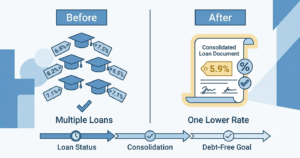
Refinancing replaces one or more student loans with a new private loan, ideally at a lower interest rate, through a private lender.
Best for: borrowers with strong credit and stable income who have private loans, or federal loan borrowers who are certain they won’t need income-driven repayment, deferment, or forgiveness options in the future.
Trade-off — and this is critical: refinancing federal loans into a private loan permanently forfeits access to federal repayment plans, forbearance, and forgiveness programs. This step generally cannot be undone. Only refinance federal loans if you’re confident you won’t need those protections.
How to Choose the Right Repayment Plan {#how-to-choose}
| Your Situation | Plan Worth Considering |
|---|---|
| Stable income, want to minimize total interest | Standard Repayment |
| Early career, expecting income growth | Graduated Repayment |
| Large balance, need lower payments now | Extended Repayment |
| Income is low or unpredictable relative to balance | Income-Driven Repayment |
| Pursuing qualifying public service work | IDR + Public Service Loan Forgiveness |
| Strong credit, private loans, or certain you won’t need federal protections | Refinancing |
Before switching plans, log in to your federal loan servicer’s portal (or studentaid.gov) to run the numbers under each option using your actual balance and income — the comparison tools there reflect current formulas, which can change with policy updates.
Frequently Asked Questions
Can I switch repayment plans later if my situation changes? Yes — federal loan borrowers can generally change repayment plans as their income or circumstances change, without penalty. This flexibility is one of the biggest advantages of federal loans over refinanced private loans.
Does income-driven repayment forgive my loan automatically after 20–25 years? Only if you’ve made qualifying payments consistently under an IDR plan for the required period. Missed payments, plan switches, or periods of deferment/forbearance can affect whether payments count toward forgiveness, so it’s worth tracking your qualifying payment count through your servicer.
Is Public Service Loan Forgiveness (PSLF) still available? PSLF exists for federal loan borrowers in qualifying public service employment who make 120 qualifying payments under an IDR plan. Program details and eligibility rules have shifted over time, so verify current requirements at studentaid.gov before relying on it as your repayment strategy.
Should I refinance federal loans for a lower interest rate? Only if you’re certain you won’t need income-driven repayment, forbearance, deferment, or forgiveness in the future — refinancing federal loans into a private loan is generally irreversible and forfeits those protections permanently.
What happens if I can’t afford any repayment plan? Contact your loan servicer before missing payments. Options like deferment, forbearance, or switching to an income-driven plan may lower or temporarily pause payments — missing payments without contacting your servicer risks default, which has serious credit and financial consequences.
The Bottom Line
There’s no single “best” student loan repayment plan — only the one that fits your income, balance, and career path right now, with the flexibility to change as those things shift. Federal borrowers in particular should run their numbers through the official comparison tools before committing to a plan or considering refinancing, since some choices — especially refinancing federal loans — can’t be undone.
Next in this series: How to Negotiate With Creditors and Lower Your Payments.