
Personal loans are fixed-sum loans you repay in equal monthly installments — and used the right way, they can lower your interest costs and simplify debt into one payment. Used the wrong way, they just become another bill stacked on top of the ones you already have.
This guide explains exactly how personal loans work, what determines your rate, and — most importantly — when taking one out actually makes financial sense.
Part of our complete guide to getting out of debt. Comparing payoff strategies first? See debt snowball vs. debt avalanche.
Table of Contents
What Is a Personal Loan? {#what-is-a-personal-loan}
A personal loan is a fixed amount of money borrowed from a bank, credit union, or online lender, repaid over a set period — typically 2 to 7 years — through equal monthly installments that cover both principal and interest.
Most personal loans are unsecured, meaning no collateral (like a house or car) backs the loan. Approval and rate depend on your credit score, income, and existing debt. A smaller share of personal loans are secured, backed by an asset such as a savings account, usually in exchange for a lower rate.
Key takeaway: unsecured personal loans are approved on creditworthiness alone; secured personal loans trade collateral for a lower rate.
How Personal Loans Work, Step by Step {#how-personal-loans-work}
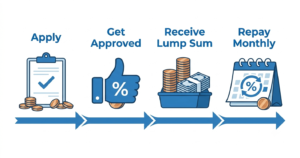
- Apply with a lender, submitting income, employment, and credit information.
- Get evaluated. The lender checks your credit score and debt-to-income ratio to set your approval and rate.
- Receive funds as a lump sum, usually deposited within a few days.
- Repay in fixed installments, typically at a fixed interest rate, over the loan term.
- Loan ends at a fixed date — unlike a credit card, there’s no revolving balance to carry indefinitely.
Because the payment and payoff date are both fixed from day one, a personal loan is more predictable than credit card debt.
What Determines Your Personal Loan Interest Rate? {#interest-rate}
Personal loan interest rates vary widely — often from single digits up to 30%+ APR — based on:
- Credit score — the single biggest factor in your rate
- Income and existing debt load — lenders confirm you can afford the new payment
- Loan term — shorter terms often mean lower rates but higher monthly payments
- Secured vs. unsecured — collateral typically lowers your rate
- Lender — banks, credit unions, and online lenders price risk differently for the same borrower
Because the range is wide, compare rates from at least two or three lenders before accepting an offer.
When a Personal Loan Makes Sense {#when-it-makes-sense}
1. Consolidating high-interest credit card debt
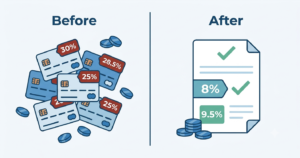
This is the most common — and often most useful — reason for a personal loan. If your credit cards charge 20%+ APR and you qualify for a meaningfully lower personal loan rate, consolidating can cut your total interest cost and combine several payments into one.
Important: if your qualifying rate is close to your card rates, consolidation won’t save much. In that case, a structured payoff plan like the debt avalanche method may work better.
2. Financing a necessary, large expense
Medical bills, urgent home repairs, or one-time costs you can’t cover from savings are reasonable uses — particularly versus high-interest credit cards or payday loans.
3. Simplifying multiple debts into one payment
Beyond interest savings, a single fixed monthly payment can reduce the mental load of tracking several due dates, even when the rate savings alone are modest.
When to Avoid a Personal Loan {#when-to-avoid}
- Covering discretionary spending — vacations or everyday purchases turn short-term wants into long-term fixed debt, often at a worse rate than expected.
- Unresolved spending habits — consolidating cards into a loan only works if you stop re-accumulating card balances afterward.
- A rate that isn’t actually better — always compare your real offered rate against your actual current rates, not an ad’s “as low as” rate.
- High fees — origination fees (often 1%–8% of the loan) reduce your proceeds or add to your balance. Factor these into your comparison, not just the headline APR.
Personal Loan vs. Credit Card: Quick Comparison {#loan-vs-credit-card}
| Factor | Personal Loan | Credit Card |
|---|---|---|
| Interest rate | Usually fixed, often lower for good credit | Usually variable, typically higher |
| Payment structure | Fixed monthly installment | Minimum payment, revolving balance |
| Payoff timeline | Fixed end date | Can extend indefinitely with minimum payments |
| Access to funds | One-time lump sum | Ongoing, reusable credit line |
| Best for | One-time expenses, consolidation | Short-term purchases you can pay off quickly |
| Risk of new debt | Lower — not reusable once repaid | Higher — credit line stays open |
How to Compare Personal Loan Offers {#compare-offers}
- APR, not just interest rate — APR includes fees for a more accurate cost comparison.
- Origination fees — ask whether they’re deducted upfront or added to your balance.
- Prepayment penalties — some lenders charge a fee for paying off early.
- Total repayment amount — multiply monthly payment × number of months, and compare totals across offers.
- Funding speed — confirm disbursement timing if you need funds urgently.
Many lenders offer a soft-credit-check rate estimate that won’t affect your credit score — use this to compare two or three offers before committing.
Frequently Asked Questions {#faq}
Will applying for a personal loan hurt my credit score? A single hard inquiry causes a small, temporary dip. Soft-inquiry rate-check tools don’t affect your score at all. On-time payments can help your credit over time; missed payments hurt it.
Can I get a personal loan with bad credit? Yes, though rates will be higher, and some lenders require a co-signer or collateral. Compare offers carefully — a high-rate loan may not beat your existing debt’s interest rate.
How is a personal loan different from a payday loan? Personal loans come from banks, credit unions, or regulated online lenders with structured repayment terms. Payday loans are short-term, extremely high-cost loans meant to be repaid by your next paycheck, carrying a much higher risk of a debt cycle.
Can I use a personal loan to pay off student loans? Technically yes, but it’s usually inadvisable — federal student loans often include borrower protections (income-driven repayment, deferment) that personal loans don’t offer. See student loan repayment options first.
The Bottom Line
A personal loan is a tool, not a solution by itself. It makes sense when it replaces higher-cost debt with a lower, fixed rate — paired with a plan to avoid re-accumulating the debt you just consolidated. It doesn’t make sense for funding ongoing spending or covering a budget gap.
Before applying, compare your current rates against real loan offers, factor in fees, and make sure the spending habits behind your debt are already under control.
Next in this series: Student Loan Repayment Options You Need to Know